
Introduction
The history of fascisterne in Denmark is more complicated than the label might suggest. Fascist and National Socialist movements did exist in Denmark, but they never gained the political control achieved by Mussolini in Italy or Hitler in Germany. Their story is therefore not one of a successful takeover. It is a story of limited political support, ideological influence from abroad, the German occupation, collaboration, resistance, and the difficult choices faced by Danish society during the Second World War.
Understanding that history requires more than looking at party names. The people involved had different motivations, organizations competed for influence, and the political situation changed sharply after Germany occupied Denmark in April 1940. The Danish experience also shows why fascism cannot be understood simply as another ordinary political movement.
How Fascism Took Hold Across Europe
Fascism developed in Europe during a period of severe political and social instability after the First World War. Millions of people had experienced the destruction of the war, economies were under pressure, and established political systems faced growing criticism. Fear of communism, anger over social conditions, and intense nationalism created an environment in which authoritarian movements could attract followers.
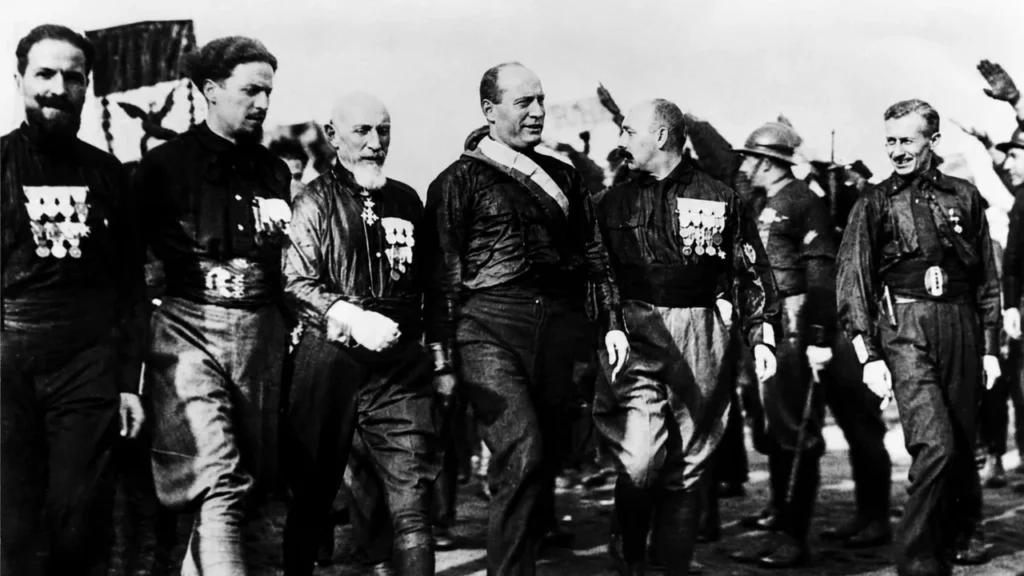
Italy provided the first major example. Benito Mussolini’s Fascist movement rejected liberal democracy and parliamentary politics while promoting strong national unity, authoritarian leadership, and loyalty to the state. Mussolini came to power in 1922 and gradually dismantled democratic institutions.
The success of Italian Fascism influenced political movements elsewhere. However, fascism did not look identical in every country. Local traditions, economic conditions, political institutions, and national conflicts shaped the movements that emerged.
Germany produced the most extreme example. Adolf Hitler’s National Socialist German Workers’ Party combined dictatorship with racial ideology, aggressive antisemitism, militarism, and territorial expansion. Once the Nazis took power in 1933, Germany rapidly became a totalitarian dictatorship.
That distinction is essential when discussing fascisterne in Denmark. Danish movements influenced by fascist and National Socialist ideas existed, but Denmark did not experience the same political transformation as Germany.
The Danish Political Environment Before the Occupation
Fascist ideas reached Denmark during the interwar period, when political movements across Europe were experimenting with alternatives to parliamentary democracy.
Danish society already had strong political organizations and established democratic traditions. Social democrats, liberals, conservatives, agrarian interests, trade unions, and other groups had developed substantial networks. That made it difficult for a new authoritarian movement to displace the existing political system.
Danish fascist groups therefore faced a basic problem: they had to persuade voters to abandon political organizations that were already deeply established.
Their message emphasized national unity, discipline, opposition to communism, and dissatisfaction with parliamentary politics. Yet these themes did not produce the mass political breakthrough that fascist movements had achieved elsewhere.
The limited electoral success of fascisterne is one of the most revealing aspects of Danish history. It demonstrates that the existence of an extremist movement does not automatically mean that the wider population has embraced its ideology.
DNSAP Became the Most Important Danish National Socialist Organization
The National Socialist Workers’ Party of Denmark, known as DNSAP, was founded in 1930. It became the best-known Danish organization associated with National Socialism.
DNSAP borrowed heavily from the German Nazi model. Its political presentation included National Socialist symbolism, nationalism, authoritarian ideas, and hostility toward communism and liberal democracy.
Frits Clausen became the central leader of DNSAP. He worked to expand the party’s influence and hoped that changing political circumstances would eventually allow it to play a much larger role in Danish government.
The party did gain supporters, but its electoral strength remained limited compared with the dominant Danish political parties.
This is where discussions about fascisterne can easily become misleading. DNSAP’s existence is historically important, but its presence should not be confused with broad Danish support for National Socialism.
A political movement can be organized, visible, and ideologically committed while still remaining a minority force.
Why Danish Fascist Movements Struggled to Gain Mass Support
Several factors explain why fascisterne failed to reproduce the political success of fascist movements in Italy and Germany.
First, Denmark’s parliamentary institutions remained functional. Political disagreements were serious, but the democratic system had not collapsed.
Second, Danish voters already had established political choices. Parties had long-standing relationships with local communities, farmers, workers, businesses, and other sections of society.
Third, Danish National Socialists were closely associated with a political model that many Danes viewed as foreign. Their admiration for Hitler’s Germany created a difficult contradiction. They promoted Danish nationalism while openly drawing inspiration from an increasingly powerful neighboring state.
The party’s opponents could therefore portray National Socialism as a threat to Danish independence as well as democracy.
The result was a movement with committed followers but limited mass appeal.
The German Occupation Changed the Political Situation
Germany invaded Denmark on April 9, 1940. The occupation transformed the political environment overnight.
The Danish government and state institutions initially remained in operation under an arrangement that involved cooperation with the German authorities. This period is often remembered as one of the most complicated chapters in Danish history because the country attempted to preserve as much domestic control as possible while living under German occupation.
For fascisterne and Danish National Socialists, the occupation created an opportunity that had not existed before.
Germany now held enormous power in Denmark, and Danish National Socialists could hope that German influence would strengthen their own political position.
But that expectation was not fulfilled.
DNSAP did not become the government of Denmark, and German occupation did not automatically produce mass support for the Danish National Socialist movement. The party remained dependent on circumstances created by Germany rather than developing the independent popular legitimacy its leaders had wanted.
Frits Clausen and the Ambitions of DNSAP
Frits Clausen played a central role in the history of Danish National Socialism. He became the most recognizable Danish political figure associated with DNSAP and attempted to position the party as the country’s natural alternative to parliamentary politics.
His ambitions became particularly significant during the occupation.
Clausen hoped that Germany’s victory would create conditions in which DNSAP could gain greater political influence. Yet the German authorities did not simply hand control of Denmark to Clausen. German policy was shaped by its own strategic interests, and maintaining a degree of administrative stability in Denmark was often more important than installing a Danish National Socialist government.
This left DNSAP in an awkward position.
It wanted to appear as a powerful national movement, but its political prospects were closely tied to an occupying foreign power.
That contradiction damaged its credibility.
Collaboration Was Not the Same as Ideological Commitment
The occupation also created a difficult question that still matters when studying fascisterne: who should be considered a committed ideological supporter and who was cooperating for other reasons?
The answer is not always obvious.
Some individuals genuinely supported National Socialist ideas. Others cooperated with German authorities because they believed cooperation could protect Danish institutions, careers, businesses, or personal interests. Some people made decisions under direct pressure.
These motivations cannot responsibly be treated as identical.
The same problem applies to resistance. A person did not necessarily have to belong to an organized resistance group to oppose German rule, just as someone who cooperated with authorities was not automatically a convinced National Socialist.
The occupation produced a broad spectrum of behavior, and reducing it to two simple camps hides more than it reveals.
Political Violence and the Fascist Method
Fascist movements historically relied on more than elections. Intimidation, political violence, propaganda, organized street activity, and the glorification of strong leadership were important elements of fascist politics.
The Italian Fascists demonstrated this before Mussolini consolidated power. Fascist squads used violence against political opponents and helped create an atmosphere in which parliamentary government appeared weak and disorderly.
German National Socialism took political violence and repression to a far more destructive level after Hitler’s rise to power.
The underlying political idea was dangerous: opponents were no longer treated as legitimate participants in democratic debate. They were portrayed as enemies of the nation.
That distinction helps explain why fascisterne should be studied as part of the wider history of authoritarian politics rather than simply as another political faction.
Once political disagreement is treated as betrayal, democratic compromise becomes almost impossible.
Propaganda Was Central to Fascist Politics
Fascist movements understood that political power depends partly on controlling the story people tell about their country.
Propaganda presented the movement as disciplined, patriotic, decisive, and capable of restoring national strength. Opponents were often depicted as weak, corrupt, disloyal, or responsible for the country’s problems.
In Denmark, National Socialist organizations used newspapers, posters, meetings, symbols, uniforms, and other forms of political communication to promote their worldview.
These methods were particularly effective at creating a sense of group identity.
Supporters were not simply asked to vote for a party. They were encouraged to see themselves as members of a movement fighting for the nation’s future.
That emotional element is important. Fascist politics often depended on belonging, fear, anger, and national pride as much as on specific policy proposals.
The Difference Between Danish Fascism and German Nazism
It is tempting to treat fascism and Nazism as exactly the same thing, but historical accuracy requires more care.
Italian Fascism developed around authoritarian nationalism, centralized leadership, rejection of liberal democracy, and the subordination of individual interests to the state.
German Nazism shared several of these characteristics but placed racial ideology and antisemitism at the heart of its political worldview. The Nazi regime eventually carried out the Holocaust and launched a war of conquest that devastated Europe.
Danish National Socialists were strongly influenced by Germany, particularly DNSAP, but Denmark’s political circumstances were different.
This does not make Danish National Socialism harmless. It means the movement should be described according to its actual history rather than by automatically transferring every feature of Nazi Germany onto Denmark.
Precision makes the historical record stronger.
The Occupation and the Failure of a Political Takeover
One of the biggest misconceptions about the Danish fascisterne is that the German occupation somehow guaranteed the success of Danish National Socialism.
It did not.
Despite the enormous change brought by German military control, DNSAP never became the dominant political force in Denmark. The existing political structure remained important for much of the occupation, and Danish National Socialists could not turn German power into widespread domestic legitimacy.
This failure says something significant about Danish society at the time.
National Socialism could operate openly enough to attract committed followers, but it could not overcome the broader political resistance to the ideology.
Foreign occupation gave the movement greater visibility and opportunity, but visibility was not the same thing as popular support.
What Happened After Germany’s Defeat?
Germany’s defeat in 1945 destroyed the political environment on which European fascist and National Socialist movements had depended.
In Denmark, people associated with collaboration and National Socialism faced a post-war reckoning. Individuals accused of collaboration could face legal proceedings, punishment, social condemnation, or loss of status.
DNSAP’s political ambitions effectively collapsed.
The post-war period also exposed the difficulty of deciding how responsibility should be assigned. There was a clear difference between active ideological support for Nazism, direct assistance to German authorities, economic collaboration, political accommodation, and behavior motivated by fear or self-preservation.
Those distinctions remain important because the history of the occupation involved thousands of individual decisions made under extraordinary circumstances.
Why the Danish Story Matters Today
The history of fascisterne remains relevant because democratic societies rarely face political extremism in a simple form.
Extremist movements can begin as minority organizations. They may appear politically insignificant for years while building networks, developing propaganda, recruiting supporters, and waiting for a crisis.
The Danish example shows the other side of that process. A movement can adopt an influential foreign ideology and still fail to achieve political dominance because established institutions, political traditions, and public attitudes resist it.
That is perhaps the most useful lesson from Denmark.
Fascism was not defeated simply because its ideas were obviously unpopular from the beginning. Political circumstances mattered. So did the strength of democratic institutions and the refusal of most voters to abandon established political structures.
The Historical Legacy of fascisterne
The legacy of fascisterne in Denmark is best understood through the gap between ambition and achievement.
Danish fascist and National Socialist groups wanted far more political influence than they actually obtained. DNSAP became the most significant National Socialist organization, but it remained a minority movement. The German occupation increased its opportunities without giving it genuine control of Denmark.
After the war, the collapse of Nazi Germany removed the international foundation that had made the movement’s ambitions seem possible.
Yet the history should not be dismissed simply because these movements failed to take power.
Their propaganda, political organization, ideological commitments, relationships with Nazi Germany, and activities during the occupation provide a window into how extremist politics can develop inside an otherwise democratic society.
The strongest lesson is straightforward: political extremism does not become important only after it wins. It deserves scrutiny while it is still testing the limits of the political system. Denmark’s experience with fascisterne shows how much democratic institutions can resist—and how important it is not to assume that resistance will always happen automatically.
Frequently Asked Questions
1. Was DNSAP popular among ordinary Danish voters?
DNSAP attracted a committed following, but it never achieved the level of mass electoral support necessary to dominate Danish politics. Established Danish parties retained far greater influence.
2. Did Germany install Frits Clausen as Denmark’s leader?
No. Although Clausen hoped the occupation would create an opportunity for DNSAP, Germany did not simply transfer control of Denmark to him. German authorities had their own strategic priorities.
3. Were all Danish collaborators fascists?
No. Collaboration covered different forms of behavior and different motivations. Ideological support for National Socialism was only one possible reason someone might cooperate with German authorities.
4. Did Danish fascist groups exist before the German occupation?
Yes. Fascist and National Socialist organizations were active in Denmark during the interwar years. DNSAP was founded in 1930, several years before Germany occupied Denmark.
5. What is the most important lesson from Denmark’s experience?
The Danish case shows that an extremist movement can exist, organize, and gain committed supporters without becoming the dominant political force. Strong institutions and established political traditions can make it much harder for authoritarian movements to convert ideology into political control.