
Introduction
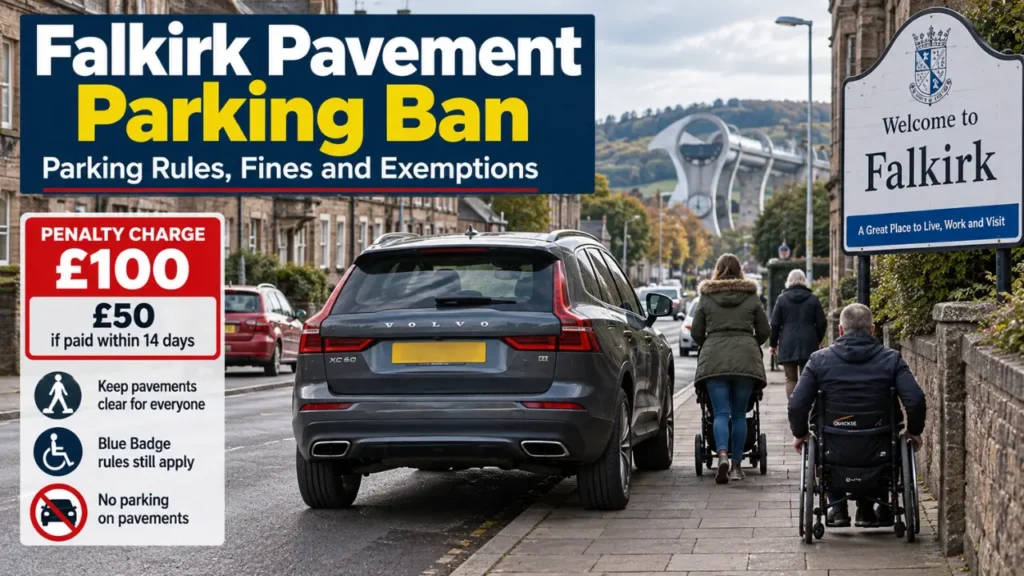
Pavement parking in Falkirk is no longer something drivers can treat as a harmless local habit. Since enforcement began on 18 August 2025, parking with wheels on the pavement can lead to a £100 penalty charge, reduced to £50 if it is paid within 14 days. The rule applies across Falkirk’s streets, including places where pavement parking may have been common for years.
The practical message for motorists is simple: if you cannot park with all four wheels on the carriageway without creating an obstruction, find another place to leave the vehicle. Falkirk Council is clear that a lack of convenient parking does not make pavement parking legal.
When did the Falkirk pavement parking ban start?
The local enforcement date was 18 August 2025, but the legal change behind it is Scottish rather than unique to Falkirk. The legislation covering pavement parking across Scotland came into force on 11 December 2023.
Falkirk Council spent time preparing for enforcement rather than immediately issuing penalties. From 7 May 2024, the council says it issued 1,800 advisory notices to give motorists an opportunity to understand the new restrictions.
That preparation period has now passed.
From 18 August 2025, the council began issuing £100 fines for pavement parking. Its announcement said all 2,360 roads across the Falkirk Council area had been assessed, with 21 streets being considered for exemptions. Those locations were not subject to enforcement while their exemption considerations were being completed.
What does the pavement parking rule actually prohibit?
The key rule is stricter than many drivers may expect.
Falkirk Council states that a vehicle must not have one or more wheels on any part of the pavement. In other words, putting only two wheels onto the pavement to leave extra room for passing traffic is still potentially an offence.
One wheel can be enough for a penalty
This is particularly important on narrow residential roads.
A driver might think that placing one wheel onto the pavement is a reasonable compromise because pedestrians still appear to have enough room. Under the rule, however, that assumption is not enough.
The council specifically warns that even one wheel on the pavement can result in a Penalty Charge Notice.
So the familiar practice of partly mounting the kerb is not a safe middle ground. If pavement parking is prohibited at the location, the better option is to keep all four wheels on the road or use another legal parking location.
How much is a pavement parking fine in Falkirk?
The standard penalty charge is £100.
There is an early-payment reduction: the charge falls to £50 if paid within 14 days of the notice being issued. Falkirk Council’s parking enforcement information confirms the same £100 charge and £50 reduced amount.
Drivers should not assume that ignoring the notice will make the problem disappear. Falkirk Council states that an unpaid charge can increase to £150.
That makes a short parking decision potentially expensive.
For someone who has always parked partly on the pavement outside their home, the important change is not simply the amount of the fine. It is the fact that the old practice can now result in formal enforcement.
Does the ban apply when there is nowhere else to park?
Yes.
This is probably one of the biggest practical concerns for residents living on streets with limited parking.
Falkirk Council directly addresses the situation where residents feel they have no alternative but to park on the pavement. Its position is that pavement parking is no longer legal in those circumstances and motorists need to find another place to park.
That may be frustrating, particularly on older streets where properties have little or no private parking.
But frustration does not create an exemption.
If parking all four wheels on the road would obstruct traffic, the council advises motorists to park elsewhere. It also notes that Police Scotland may take action where vehicles obstruct traffic.
What about wide pavements?
A wide pavement does not automatically mean that cars can use it.
This is another area where old parking habits can create confusion. A driver may look at a broad pavement and conclude that there is plenty of space for both a vehicle and pedestrians.
Falkirk Council’s explanation takes a different approach. Pedestrian access is prioritised, and exemptions are only appropriate in specific circumstances. The council also points out that many pavements were not designed to withstand the weight of vehicles over long periods.
That matters because repeated pavement parking can cause physical damage as well as obstruct pedestrians.
The argument that “there is plenty of room” is therefore not enough on its own.
Does the rule apply to cul-de-sacs?
Yes.
The design of the street does not remove the prohibition.
Falkirk Council says the rules apply to all streets regardless of their design, length or purpose. That includes cul-de-sacs where pedestrian traffic may appear light.
A quiet residential street therefore should not be treated as an unofficial exception.
The same principle applies to private roads or privately owned pavements when the road is available for pedestrians to use.
Double parking is also prohibited
The falkirk pavement parking ban is not the only restriction drivers need to understand.
Falkirk Council also enforces a double-parking prohibition. This covers parking alongside or in front of another vehicle, as well as vehicles positioned more than 50 centimetres from the edge of the carriageway.
That can matter on streets where drivers leave their cars partly away from the kerb to make room for other vehicles.
The intention is not simply to make roads look tidier. Poorly positioned vehicles can restrict the usable road space and make it harder for traffic, emergency vehicles and other road users to get through.
If keeping all four wheels on the road creates an obstruction, parking somewhere else is the safer choice.
Dropped kerbs are another area of enforcement
Drivers also need to watch for dropped footways and crossing points.
The restriction covers locations where a footway has been lowered, or where the carriageway has been raised, to help pedestrians or cyclists cross.
That means a dropped crossing point should not be treated as an ordinary kerbside parking space.
How can you recognise a crossing point?
Falkirk Council suggests looking at the purpose of the dropped kerb.
If there is no driveway or garage corresponding to the lowered section, it may be intended as a pedestrian or cycling crossing point.
The safest approach when unsure is to leave the area clear.
Blocking a crossing can create a particular problem for wheelchair users, people with mobility difficulties and pedestrians who need a continuous accessible route.
Are there exceptions to the Falkirk pavement parking ban?
There are limited exceptions, but they are tied to specific activities.
Falkirk Council lists emergency-service vehicles among the situations covered by exceptions. Certain vehicles carrying out road works, removing traffic obstructions, collecting council waste or delivering Royal Mail postal services can also qualify.
There are provisions for registered medical practitioners, registered nurses and registered midwives providing urgent or emergency healthcare.
The rules also provide exceptions connected with goods deliveries, collections and loading or unloading, but these are subject to strict conditions and a maximum period of 20 minutes.
The 1.5-metre condition
An exception does not mean a vehicle can simply occupy as much pavement as necessary.
Where the applicable exception requires pavement use, there must still be 1.5 metres of unobstructed footway between the vehicle and the edge of the footway furthest from the carriageway.
For business deliveries and loading, Falkirk Council also says there must be no reasonable place to park fully on the road.
That is an important distinction. A delivery driver cannot automatically claim an exemption simply because stopping on the pavement is more convenient.
Can you use the pavement to drop someone off?
No.
Falkirk Council specifically says drivers should not drive onto the pavement to allow a passenger to board or leave a vehicle.
This is worth knowing because a driver may see passenger drop-off as different from parking. The council’s guidance does not treat it as a general exception.
If a vehicle is observed sitting on the pavement, a parking attendant can ask the driver to move before a penalty is issued.
Do Blue Badge holders have an exemption?
No.
The falkirk pavement parking ban applies to Blue Badge holders too. Falkirk Council explicitly states that there are no exceptions for Blue Badge holders under these rules.
This is an important distinction because Blue Badge concessions do not provide unrestricted permission to park wherever a driver needs.
A Blue Badge holder still needs to consider the pavement-parking prohibition, dropped-footway restrictions and other applicable parking rules.
Are taxis exempt?
No.
Falkirk Council states that taxis are not exempt and taxi drivers are expected to park or wait correctly.
This matters at busy locations where taxis may traditionally stop close to entrances or kerbs. The fact that a vehicle is being used as a taxi does not create a general right to occupy the pavement.
Why aren’t there signs on every street?
Drivers should not expect a sign at every location where pavement parking is prohibited.
The default position is that pavement parking is banned. Falkirk Council says signage will only be provided where there is a formal exemption.
That is an important difference from traditional parking restrictions.
A driver cannot reasonably argue that pavement parking was allowed simply because there was no sign saying otherwise. The absence of a sign is not an invitation to put wheels onto the pavement.
Which Falkirk streets are being considered for exemptions?
Falkirk Council currently lists 21 roads being considered for exemption.
They include:
Airth, Avonbridge and Banknock
- Netherby Road, Airth
- Hareburn Avenue, Avonbridge
- Glenview Avenue, Banknock
- Hillhead Avenue, Banknock
- Linden Drive, Banknock
Bo’ness, Bonnybridge and Denny
- Bridgeness Lane, Bo’ness
- School Brae, Bo’ness
- Skene Street, Bonnybridge
- Gorrie Street, Denny
Falkirk and Grangemouth
- Arnothill Gardens, Falkirk
- Campfield Street, Falkirk
- Russel Street, Falkirk
- Abbotsford Drive, Grangemouth
- Bearcroft Gardens, Grangemouth
- Maryflats Place, Grangemouth
Haggs, Maddiston, Stenhousemuir and Stoneywood
- John Street, Haggs
- Forgie Crescent, Maddiston
- Torosay Avenue, Maddiston
- Steps Street, Stenhousemuir
- Waverly Road, Stenhousemuir
- Hookney Terrace, Stoneywood
These locations should be described as being considered for exemption rather than automatically treated as permanently exempt. Falkirk Council’s current FAQ uses that wording.
What does a street need to qualify for an exemption?
Falkirk Council sets out specific criteria.
The carriageway must be too narrow to allow emergency-service vehicles to pass when vehicles are fully parked on the road. The footway must also be wide enough to accommodate a parked vehicle while retaining an unobstructed 1.5-metre space for pedestrians.
That means a street does not qualify merely because residents prefer pavement parking or because parking is inconvenient.
The exemption process is designed for locations where the physical characteristics of the street create a genuine problem.
Residents who believe their location meets the criteria can ask Falkirk Council to consider it.
What should drivers do on narrow residential streets?
The sensible approach is to separate inconvenience from obstruction.
If all four wheels can remain on the carriageway while traffic can still pass safely, that is preferable to mounting the pavement.
If doing so would block traffic, Falkirk Council advises finding another location rather than moving the vehicle onto the pavement.
This may mean parking farther away and walking back to the property. That is not always convenient, but it avoids turning pedestrian space into vehicle space.
The falkirk pavement parking ban is deliberately changing the old assumption that residents can solve parking shortages by using the pavement.
Why pedestrian access is at the centre of the rule
The strongest argument for the restrictions is not the fine.
It is accessibility.
A pavement that looks usable from inside a car can be difficult or impossible for someone with limited mobility to navigate. Parked vehicles can force wheelchair users, people with sight loss and families using prams or buggies into the road.
Falkirk Council’s enforcement announcement specifically highlights the effect on people with sensory impairments, mobility issues, wheelchair users and families with prams or buggies.
That changes the way the parking problem should be viewed.
The question is not simply whether a pedestrian can squeeze through the remaining gap. The question is whether the pavement remains a safe, practical and accessible route.
What happens if you receive a Penalty Charge Notice?
A Penalty Charge Notice identifies the vehicle, the alleged contravention and the relevant payment information.
If you believe the notice was issued incorrectly, Falkirk Council provides a process for challenging a parking fine.
It is better to examine the circumstances carefully than to rely on arguments such as “other cars were parked there” or “there was no sign.”
Those points do not automatically establish that the vehicle was legally parked.
A driver should instead consider the exact location, the position of the vehicle, whether an exception genuinely applied and whether another restriction was relevant.
If the notice is valid, paying within 14 days reduces the charge to £50.
Where can pavement parking be reported?
Falkirk Council says pavement parking, double parking and dropped-footway parking can be reported by email to its parking service.
That gives residents a formal route for raising recurring problems rather than relying on arguments with individual drivers.
It is particularly useful where a location repeatedly creates difficulties for pedestrians or where vehicles consistently block a crossing point.
The important distinction is that reporting a problem does not mean every reported vehicle will automatically receive a penalty. Enforcement depends on the circumstances and applicable restrictions.
The practical reality for Falkirk motorists
The falkirk pavement parking ban changes an everyday habit that had become normal on some streets.
A driver might once have viewed putting two wheels on the pavement as the polite thing to do because it left the road clear. The new rules reject that logic where pavement parking is prohibited.
The road is not automatically the problem because cars are parked there.
If a vehicle can remain safely on the carriageway, the pavement should remain available for pedestrians.
The council’s approach also makes it clear that the rules are not limited to busy town centres. They apply in cul-de-sacs and on private roads that are available to pedestrians, subject to the applicable legal restrictions and exemptions.
That is why drivers should change the habit rather than wait for enforcement to reach their particular street.
What drivers should remember
The most important facts are straightforward.
The falkirk pavement parking ban is enforceable. A vehicle with one wheel on the pavement can potentially receive a penalty. The standard charge is £100, with a reduction to £50 when paid within 14 days.
Blue Badge holders and taxis do not have a blanket exemption. Delivery, loading, emergency and certain healthcare activities can qualify under specific conditions, but those exceptions are not designed for ordinary residential parking.
There is also no requirement for a prohibition sign to appear on every street.
Most importantly, “there was nowhere else to park” is not a legal exemption.
Falkirk’s parking landscape has changed. Drivers who continue to use pavements as overflow parking are taking a financial risk, but pedestrians are the people who bear the greater practical cost when those spaces are blocked.
The sensible line is clear: keep the pavement clear, keep all four wheels on the road where lawful, and use another parking location when the road cannot safely accommodate the vehicle. A few extra minutes of walking is a far better outcome than a £100 parking notice or an inaccessible pavement.
FAQs
1. Can I park partly on the pavement if pedestrians still have plenty of room?
No. The available space does not by itself make pavement parking legal. Falkirk Council states that one or more wheels on any part of the pavement can fall under the prohibition.
2. Does the 20-minute delivery exception apply when I am unloading my shopping?
No. Falkirk Council says the delivery and loading exception applies to activity carried out in the course of business. Personal activities such as unloading shopping are not covered by that exception.
3. Can I park across my own driveway?
Potentially. Falkirk Council says you may be able to park across your own driveway if the dropped kerb does not also serve as a pedestrian crossing point and no other parking restriction applies. Parking across someone else’s driveway is different.
4. What if my car is fully on the road but emergency vehicles cannot get through?
You should not solve the problem by moving the vehicle onto the pavement. Falkirk Council advises drivers to park elsewhere if parking on the carriageway would obstruct traffic, and obstruction can also become a matter for Police Scotland.
5. Are the 21 streets listed by Falkirk Council already permanently exempt?
No. They are listed as roads currently being considered for exemption. Drivers should not assume that being on the list automatically means unrestricted pavement parking is permitted.