
Introduction
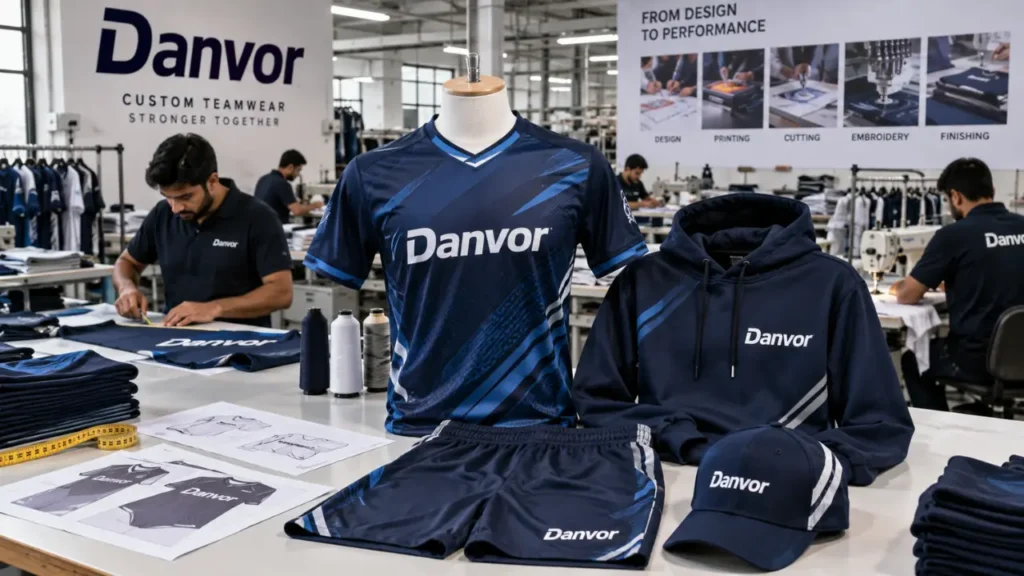
danvor Industry stands out most clearly as a custom sportswear and team-wear manufacturer where the production process matters as much as the finished design. Its published manufacturing process covers product design, sublimation, heat pressing, precision cutting, embroidery, and final ironing before quality checking and packaging. That combination gives sports teams and apparel buyers a practical route from an idea on paper to a finished garment.
For anyone considering custom sportswear, that production chain deserves more attention than flashy product images. A team uniform has to look right, fit correctly, carry its graphics cleanly, and remain presentable after real use. danvor positions its work around those manufacturing stages rather than treating customization as a single printing step.
danvor’s focus on custom team wear
Custom teamwear is different from buying standard sports clothing from a retail shelf. A club, academy, school, or sports organization may need its own colors, logos, player numbers, names, patterns, and other identifying details. The manufacturer has to turn those specifications into a consistent set of garments.
danvor presents custom team wear as a central part of its business. Its company information describes a mission centered on producing sportswear for athletes, with quality, integrity, sustainability, and reliability included among its stated values.
That distinction is important for buyers. The real test of a custom manufacturer is not whether it can create one attractive sample. The harder task is reproducing that design accurately across an entire order.
A team may need shirts in several sizes while keeping colors, logos, numbers, and overall construction consistent. That requires coordination between design, fabric preparation, printing, cutting, garment construction, decoration, and finishing.
How the danvor production process works
danvor describes a production sequence that starts with design and continues through several specialized manufacturing stages. Each stage has a different purpose, and the quality of the final garment depends on how well those stages work together.
Product design comes first
The process begins with product design. According to the company’s published information, designers and product developers work with patterns, logos, colors, and styles using design software.
This is where a team concept becomes a practical garment specification.
A logo may look excellent on a computer screen but still need adjustments before it can be applied to fabric. Placement, proportions, colors, panel shapes, and garment dimensions all have to work together.
Good design for sportswear is therefore not simply about making something attractive. It is about creating artwork that can be reproduced on an actual garment.
Sublimation adds detailed graphics
Sublimation is one of the key production methods listed by danvor. The company describes the process as using heat and pressure to fuse ink into the fabric fibers.
That makes sublimation particularly useful for sportswear with detailed graphics, patterns, multiple colors, or broad areas of printed design.
For a team, this can create much more freedom than relying on a small chest logo. A jersey can incorporate a club’s color scheme, geometric patterns, gradients, sponsor graphics, or other visual elements as part of the overall design.
The quality of the original artwork still matters. A manufacturer can reproduce a design only as accurately as the supplied artwork and production specifications allow.
Heat pressing handles selected customization
danvor also lists a heat-press stage for logos, numbers, and custom graphics. Heat and pressure are used to secure vinyl or transfer prints onto the fabric.
This method can be useful when a design requires individual elements that are better handled separately from a full sublimated graphic.
Player numbers are a straightforward example. A team might use the same base shirt design for the entire squad while changing the number and name for each player.
That means customization is not necessarily one single process. Different parts of a garment may require different production techniques.
Precision cutting affects the final fit
Printing tends to receive the attention because customers see the artwork first. Cutting is less visible, but it is just as important to the finished garment.
danvor describes fabric being cut into panels such as sleeves, fronts, backs, and collars according to size patterns. The company specifically connects precision cutting with accurate fitting.
This stage becomes particularly important when an order includes multiple sizes.
A team may require youth sizes alongside adult sizes, or several garment dimensions for different players. Each panel needs to follow the appropriate pattern so the pieces can be assembled into the intended shape.
A visually impressive design cannot compensate for a poorly fitting garment. Sportswear has to allow movement, and the cutting stage plays a direct role in how the finished item sits on the body.
Embroidery gives selected details a different finish
Not every sportswear design needs to be produced entirely through printed graphics.
danvor includes embroidery among its manufacturing services, describing embroidery machines being used for logos, crests, and detailed designs.
That can be useful for team badges, club branding, staff clothing, jackets, and other garments where a stitched finish suits the material and design.
The choice between embroidery and printing depends on the garment and the desired result. A large graphic covering a lightweight jersey may be better suited to printing, while a smaller crest on a heavier garment may work well as embroidery.
For buyers, the important question is not which method sounds more premium. It is which method fits the specific garment.
Final pressing gives the garment a finished appearance
Production does not stop once the artwork and panels are complete.
danvor describes an ironing or pressing stage before final quality checking and packaging. The stated purpose is to remove wrinkles and give the garment a clean finished appearance before it moves toward delivery.
This final stage can make a noticeable difference when garments are being prepared for a team order.
A finished uniform should arrive in a condition that reflects the work invested in its production. Pressing, inspection, and packaging are therefore not merely cosmetic steps. They are part of presenting the completed product properly.
What danvor’s sportswear range tells buyers
The published sportswear category shows a range of products rather than a single type of team jersey. The category includes items such as caps and hoodies, with the site displaying multiple products within its sportswear collection.
That matters because sports organizations often need more than match-day shirts.
A club may need training clothing, casual team apparel, warm layers, accessories, or branded items for players and staff. Keeping related products within a custom apparel program can make the visual identity of a team more consistent.
A hoodie, for example, serves a different purpose from a match jersey. It may be worn during travel, warm-ups, training, or everyday activities while still carrying the team’s identity.
The same principle applies to accessories such as caps. They can extend team branding beyond the playing field.
Why customization matters to sports teams
The strongest reason to choose custom teamwear is identity.
A sports club is not simply buying fabric and printing. It is creating something players wear as a representation of the team. Colors, badges, numbers, names, and design elements all contribute to that identity.
Custom clothing can also help distinguish different teams within the same organization.
A school might have separate football, basketball, cricket, or athletics teams. An academy may need different garments for training groups. A club may want home, away, training, and travel apparel that all share a recognizable visual style.
danvor’s manufacturing model is suited to this type of requirement because its process is built around customization from design through production.
The difference between a good design and a good sports garment
A common mistake in custom apparel is to judge a manufacturer almost entirely by the artwork.
That is the wrong test.
A strong design can attract attention, but the garment still has to work in practice. Players need to move comfortably. Graphics need to be positioned correctly. Sizes need to match the intended measurements. Decorative elements need to suit the material. The finished garments need to look consistent as a group.
The manufacturing process described by danvor addresses several of those stages directly.
Design controls the visual concept. Sublimation and heat pressing apply graphics. Cutting creates the garment panels. Embroidery adds selected details. Pressing prepares the completed garments for inspection and packaging.
That is why looking at the production sequence can tell a buyer more than looking at a product photograph alone.
What buyers should confirm before ordering
A custom sportswear order should begin with clear specifications.
Before placing an order with danvor, a buyer should have the main design details ready. That includes the preferred colors, logos, player numbers, names where required, garment types, sizes, quantities, and any specific branding instructions.
Artwork quality should also be considered early.
If a club logo is supplied in a low-resolution format, the manufacturer may need a better file before production. Similarly, colors shown on a screen may need to be clarified when accurate reproduction is important.
Sizing deserves equal attention.
A team order can include several garment sizes, so buyers should confirm the available size information and make sure measurements are appropriate before bulk production.
The production timeline should also be discussed in advance, especially when the clothing is needed for a tournament, league season, school event, or fixed launch date.
These details are not minor administrative issues. They can determine whether a custom order works smoothly.
danvor and the importance of quality control
Quality control is where a manufacturing process proves whether its earlier stages were handled correctly.
danvor’s published production description places quality checking after the garment has passed through design, sublimation, heat pressing, cutting, embroidery, and ironing.
That sequence makes sense. A final inspection can identify visible problems before the garments are packaged.
For teamwear, consistency is especially important.
Imagine receiving a squad order where one shirt has a misplaced logo, another has an incorrect number, and another has a noticeably different finish. Even if most of the order is correct, those errors become obvious when the garments are worn together.
Quality control therefore needs to be viewed from the customer’s perspective. It is not just about whether a garment technically exists. It is about whether the finished item matches the agreed design and specifications.
Where danvor fits within Sialkot’s sportswear industry
danvor Industries has a LinkedIn listing associated with Sialkot, Punjab, Pakistan.
That location is relevant because Sialkot has a well-established manufacturing base for sporting goods and sportswear. Current manufacturers in the area advertise custom teamwear, activewear, OEM production, printing, embroidery, cutting, and related apparel services.
However, location should not be mistaken for proof of quality.
A buyer still needs to assess the individual manufacturer, the specifications of the garment, the production process, samples where available, communication, and the terms of the order.
For danvor, the useful point is that its publicly described operations fit within a wider Sialkot manufacturing environment where customized sports apparel is an established business category.
What makes danvor relevant to custom apparel buyers
The strongest case for danvor is its focus on the practical stages required to manufacture customized sportswear.
The company does not present customization as simply adding a logo to an existing garment. Its published process begins with design and moves through sublimation, heat pressing, cutting, embroidery, and final pressing.
That gives buyers a clearer picture of how a custom garment can move from concept to finished product.
Still, buyers should separate published capabilities from assumptions.
If you need a particular fabric, garment style, quantity, decoration method, size range, or delivery schedule, those details should be confirmed directly before an order is finalized. A general manufacturing capability does not automatically mean every possible specification is available for every product.
That distinction protects the buyer from making decisions based on assumptions.
The smartest way to approach a custom teamwear order
The best approach is to treat the order as a production project rather than a simple shopping purchase.
Start with the design.
Then define the garments.
After that, establish sizes, quantities, branding requirements, artwork, and the desired delivery schedule. Ask which production methods are appropriate for each part of the design.
If samples are available, use them to assess the actual garment rather than relying only on a digital representation.
Once the specifications are clear, the buyer has a much stronger basis for evaluating the final order.
This approach also makes communication easier. Instead of saying that you want a “professional-looking team kit,” you can provide specific requirements that a manufacturer can actually work with.
The real strength of danvor is the production chain
danvor is most interesting when viewed through the full manufacturing process.
The company’s published information connects design, sublimation, heat pressing, cutting, embroidery, and finishing into one production sequence.
That matters because sportswear quality is cumulative. A good design cannot rescue inaccurate cutting. Good printing cannot compensate for poor sizing. A well-cut garment can still look unfinished if the final presentation is neglected.
Every stage contributes to the result.
For clubs and organizations considering custom apparel, that is the point worth remembering. The question should not simply be whether danvor can produce attractive sportswear. The more useful question is whether its available production methods match the exact requirements of the project.
Final takeaway
danvor has a clear place in the custom sportswear conversation because its published manufacturing process covers the stages that turn a team concept into a finished garment. Design, sublimation, heat pressing, cutting, embroidery, and final pressing each solve a different production requirement, and together they create the foundation for customized teamwear.
For buyers, the smartest move is to stay specific. Know what you want, prepare accurate artwork, confirm sizing and production requirements, and establish expectations before approving an order.
A sports uniform should not win approval simply because it looks impressive on a screen. It has to make sense as a real garment, for real players, under real conditions. That is where the quality of a manufacturer is ultimately tested.
FAQs
1. Does danvor manufacture only jerseys?
No. Its published sportswear category shows a broader selection that includes products such as caps and hoodies alongside other sportswear items. The exact availability of a particular product should be confirmed before ordering.
2. What customization methods does danvor list?
The published production information lists sublimation, heat pressing, embroidery, and design-based customization. It also describes precision cutting and final ironing as parts of the manufacturing process.
3. Is danvor associated with Sialkot, Pakistan?
Yes. A LinkedIn listing for Danvor Industries identifies Sialkot, Punjab, Pakistan, and the company’s sportswear manufacturing presence is associated with that location.
4. Why might sublimation be useful for team uniforms?
Sublimation can be useful when a uniform requires detailed, colorful, or broad-area graphics. danvor describes using heat and pressure to fuse the ink into the fabric fibers during sublimation.
5. What should a team confirm before placing a custom order?
The most important details are the garment type, design, artwork, colors, sizes, quantities, customization requirements, and expected production timeline. Confirming these details early reduces the risk of misunderstandings during manufacturing.