
Introduction
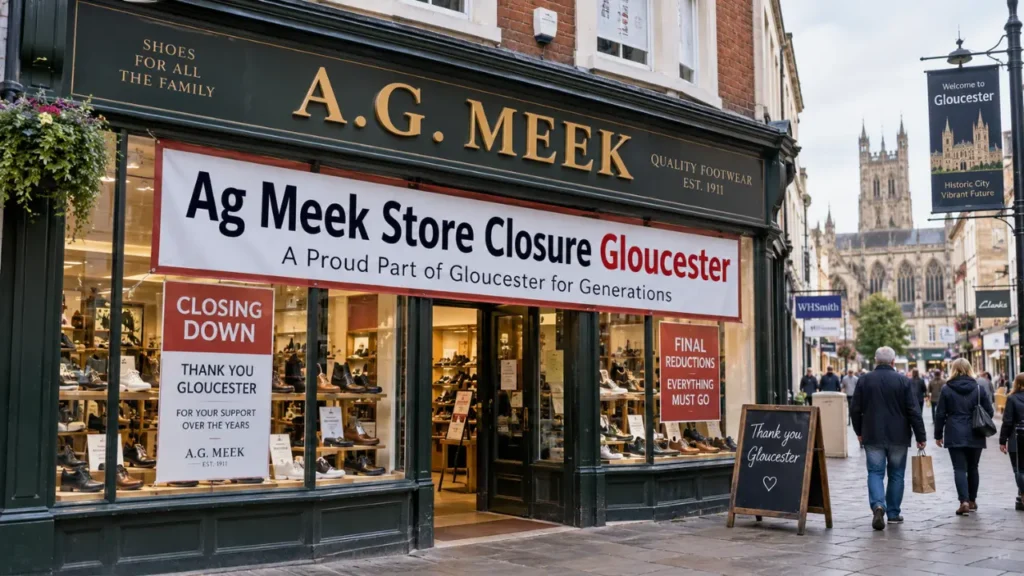
The ag meek store closure gloucester was a genuine loss for the city, not because Gloucester had lost another ordinary shoe shop, but because it lost a retailer that had been part of the local shopping scene since 1965. After six decades in the city, A.G. Meek finally shut its Eastgate Street branch in April 2025. The reason was brutally practical: falling footfall and rising costs had made the shop financially unsustainable.
That distinction matters. A.G. Meek did not close because it lacked history, customer recognition or an established product range. It had all three. The Gloucester branch had survived for generations, moved to a more central location in 2021 and continued selling established footwear brands. But a loyal customer base cannot compensate forever when the economics of a physical shop stop working.
The closure leaves behind an empty retail unit on Eastgate Street and a much bigger question about what Gloucester needs to do if independent retailers are going to survive there.
A.G. Meek had been part of Gloucester since 1965
A.G. Meek’s Gloucester story began in 1965, when the company opened a shop on Westgate Street in a Georgian-fronted Tudor building. That gave the retailer an unusually long connection with the city and made its eventual departure far more significant than a routine change of business.
The company itself was considerably older than its Gloucester branch. A.G. Meek was founded in Cardiff in 1912 by Albert George Meek. Its history later included the famous “Meek’s Sets” of the 1950s, when matching shoes, bags and gloves became a distinctive part of the retailer’s identity.
That background helps explain why the ag meek store closure gloucester attracted attention from local shoppers. The business was not an unfamiliar name arriving briefly on a high street. It had built decades of recognition among Gloucester customers.
There was also a practical side to its appeal. The Gloucester store stocked footwear from brands including Kickers, Skechers, Timberland, Rieker, Tamaris, Marco Tozzi, Hotter and Van Dal.
Why A.G. Meek moved to Eastgate Street
The Gloucester branch did not remain on Westgate Street throughout its later years.
In October 2021, A.G. Meek moved into the former Accessorize premises on Eastgate Street. The company believed the new location was more central and hoped the position opposite the new Primark would help attract customers. Management also saw an opportunity to benefit from shoppers visiting M&S and other established retailers nearby.
At the time, the move looked like a sensible attempt to strengthen the business rather than retreat from Gloucester.
The company wanted to retain its existing customers while bringing new shoppers through the door. That decision is important when looking at the ag meek store closure gloucester because it shows that the business had already tried to improve the branch’s position before eventually deciding that the numbers no longer worked.
The Eastgate Street shop opened in October 2021. Less than four years later, it would be gone.
The real problem was falling footfall
The clearest explanation for the closure came from the business itself.
Local reporting quoted a member of staff saying the shop was closing because the business no longer received the footfall it needed on Eastgate Street. Later reporting carried comments from owner David Meek stating that the shop had been struggling with rapidly rising costs and reduced footfall since the pandemic and was not covering its costs.
That is the central fact behind the closure.
It is easy to reduce struggling high-street businesses to competition from online shopping, but A.G. Meek’s explanation was more specific. Customers were not visiting the city centre in sufficient numbers, while the costs associated with operating the shop were moving in the opposite direction.
For a physical retailer, that combination is dangerous.
A shop can only pay staff, rent, rates, utilities and other expenses if enough customers come through the door and spend money. Once footfall falls below a sustainable level, even a respected independent retailer can find itself losing money simply by remaining open.
The ag meek store closure gloucester therefore says less about the popularity of shoes and more about the economics of maintaining a physical retail business in a city centre.
Rising business costs made the decision harder
The Gloucester branch was also facing a fresh increase in operating costs.
Reports on the closure highlighted changes to employer National Insurance contributions and a reduction in business-rates relief. Owner David Meek said the combined effect would add thousands of pounds a year to the cost of running the shop, making the situation unsustainable.
The timing was particularly difficult.
The closure came as businesses were preparing for changes to employer National Insurance contributions from April 2025. The rate was scheduled to rise from 13.8% to 15%, while the earnings threshold at which employers began paying the contribution was being reduced from £9,100 to £5,000. Retail business-rates relief was also due to fall from 75% to 40%.
For a shop employing five staff, these changes were not abstract figures. They fed directly into the cost of keeping the doors open. Local reporting identified five employees at the Gloucester store when the closure was announced.
That helps explain why the closure decision became unavoidable.
The pandemic left a lasting effect on the branch
A.G. Meek’s management also pointed to reduced footfall since the pandemic.
That detail should not be overlooked. The Gloucester store survived the immediate disruption of COVID-19, but surviving the disruption did not mean returning to the same trading environment that existed beforehand.
The business said the shop had continued to struggle with lower customer numbers and rapidly rising expenses after the pandemic. In other words, the problem was not simply one difficult month or one bad trading period. The branch had been under pressure for a sustained period before the final decision was made.
The ag meek store closure gloucester was therefore the end point of a financial problem that had been building rather than a sudden reaction to one event.
When did the Gloucester A.G. Meek shop close?
The closure was announced in January 2025, when the company said the Eastgate Street store would close in April. A closing-down sale began before the final day.
The reported final trading date was 12 April 2025. By that point, stock had been substantially reduced and discounted footwear was being sold as the shop prepared to close permanently.
This gives the ag meek store closure gloucester story a definite timeline:
- The Gloucester branch opened in 1965.
- It moved from Westgate Street to Eastgate Street in October 2021.
- The closure was announced in January 2025.
- The final trading date was reported as 12 April 2025.
Those dates show just how long A.G. Meek remained part of Gloucester’s retail scene before the final chapter.
The closing-down sale brought customers back for one last visit
The closing-down sale was more than a conventional stock-clearance exercise.
Customers had a final opportunity to buy from a shop that had served Gloucester for decades. Reports highlighted discounts on branded footwear as the store reduced its remaining stock before closure.
The response from local shoppers also showed that the shop had built genuine loyalty.
Comments from customers expressed sadness about losing the business, with people recalling buying shoes, handbags, gloves and wedding footwear from A.G. Meek.
That reaction is important because it demonstrates the difference between a retailer having customers and a retailer becoming part of a city’s identity.
A.G. Meek had achieved the latter.
The Eastgate Street location is now vacant
The former A.G. Meek premises has not simply disappeared from local records.
Gloucester BID currently lists 32 Eastgate Street as vacant and identifies the property as the former A.G. Meek shoe shop.
That creates an interesting next chapter for the location.
The immediate issue is no longer whether A.G. Meek can make the shop work. That decision has already been made. The question is what kind of business can succeed in the space next and whether Gloucester can attract a retailer that gives shoppers a reason to visit rather than simply filling the unit.
That distinction matters.
An occupied shop is not automatically a successful high-street shop. The stronger outcome would be a business that attracts regular customers and contributes to the wider activity of Eastgate Street.
The closure should not be confused with the end of A.G. Meek
There is another important distinction when discussing the ag meek store closure gloucester.
The closure was specifically about the Gloucester branch. Contemporary reporting said the company’s Welsh stores were expected to remain open, and later coverage reported that the chain continued with four remaining sites in Wales.
So it would be inaccurate to describe the Gloucester closure as the complete disappearance of A.G. Meek.
The business’s Cardiff origins stretch back to 1912, and its operations outside Gloucester continued after the Eastgate Street branch shut.
For readers searching for what happened to A.G. Meek, that distinction is essential: Gloucester lost its branch, but the wider business did not simply cease to exist at the same time.
What the closure says about Gloucester’s independent shops
The ag meek store closure gloucester is ultimately a story about commercial pressure.
The retailer had history. It had a recognisable name. It had established brands. It had loyal customers. It even moved to a location it believed would provide better visibility and stronger customer traffic.
Still, the branch could not make the numbers work.
That is the uncomfortable part of the story.
Independent businesses can be valued by customers and still fail commercially. Goodwill does not cancel rent. Reputation does not remove business rates. Loyal customers cannot compensate indefinitely for a sustained shortage of footfall.
Gloucester’s challenge is therefore not simply finding replacements for closed shops. It is creating conditions where independent retailers can generate enough business to justify staying in the city centre.
A.G. Meek’s experience makes that point unusually clearly.
Why the A.G. Meek story still matters
The ag meek store closure gloucester matters because the branch represented 60 years of continuity.
The business had seen Gloucester change around it. It survived the transition from traditional shopping habits to modern retail, adapted its location and continued serving customers through major changes in the industry.
But adaptation has a limit.
When the cost of operating a physical store rises while the number of customers visiting the location falls, there eventually comes a point where history cannot justify another financial loss.
That is what makes the closure more significant than a simple “shop shuts” headline.
A.G. Meek’s Gloucester branch did not disappear because its history stopped mattering. It disappeared because the economics of keeping that particular branch open stopped making sense.
That is a much harder problem for a city to solve.
A.G. Meek’s Gloucester chapter has ended, but the lesson remains
The ag meek store closure gloucester should be remembered as the end of a six-decade local retail relationship, but nostalgia should not obscure the reason the shop closed.
The business tried moving to Eastgate Street. It continued serving customers. It maintained a specialist footwear offer. Yet falling footfall and rising operating costs eventually pushed the Gloucester branch beyond what it could sustain.
That should concern anyone who cares about Gloucester’s independent retail scene.
The next shop to occupy the former A.G. Meek unit will have a chance to write a new story. But if the underlying problem is weak footfall combined with high operating costs, simply changing the name above the door will not solve it.
A.G. Meek lasted 60 years in Gloucester. The real challenge now is making sure the next independent retailer has a reason to believe it can last that long too.
FAQs
1. Did A.G. Meek close all of its shops when Gloucester closed?
No. The Gloucester branch was closed, while contemporary reporting stated that the company’s Welsh stores would remain open. Later reporting described four remaining A.G. Meek sites, all in Wales.
2. What was the last location of A.G. Meek in Gloucester?
The final Gloucester shop was on Eastgate Street. The company moved there from Westgate Street in October 2021, taking over the former Accessorize premises.
3. How long had A.G. Meek traded in Gloucester?
The Gloucester branch had been trading since 1965, meaning it had a presence in the city for around 60 years before closing in 2025.
4. Was low customer traffic the only reason for the closure?
No. Reduced footfall was a major factor, but the business also cited rapidly rising operating costs, changes to employer National Insurance and reduced business-rates relief. The company said the shop was not covering its costs.
5. What happened to the former A.G. Meek premises?
Gloucester BID currently lists 32 Eastgate Street as vacant and identifies it as the former A.G. Meek shoe shop.