
Introduction
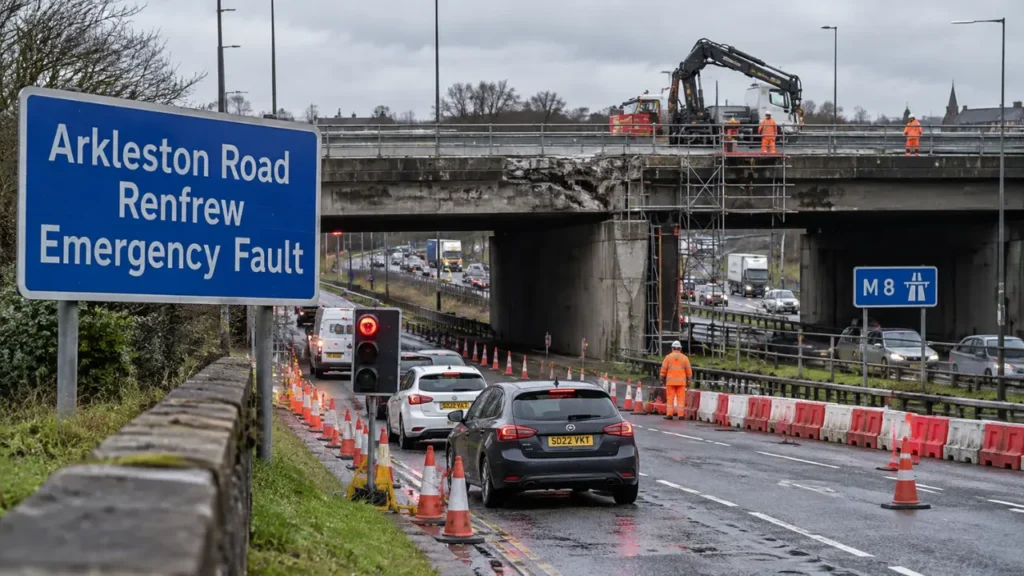
The biggest mistake in reporting the arkleston road renfrew emergency fault is treating every problem reported on the road as one single incident. The confirmed event that triggered the long-running emergency restrictions was a lorry carrying a heavy load striking the bridge over the M8 on June 4, 2025. Police Scotland said the collision happened at about 2:50pm and confirmed that Arkleston Road in Renfrew would remain closed for the foreseeable future.
The consequences were immediate. The M8 westbound carriageway was temporarily closed while debris was cleared and the bridge was inspected, while the road above the motorway faced a much longer restriction. The current roadworks listing still records the Arkleston Road overbridge works as an emergency scheme, with the listed period running from June 4, 2025, to December 31, 2026.
That makes the arkleston road renfrew emergency fault a story about structural damage, traffic management and a road network that cannot easily absorb the loss of an important crossing.
The June 2025 bridge collision started the disruption
The incident took place on Wednesday, June 4, 2025.
According to Police Scotland, a lorry carrying a heavy load collided with the bridge over the M8 at around 2:50pm. Officers subsequently appealed for witnesses and asked motorists with dashcam footage to come forward.
The collision caused an immediate problem for both levels of the road network.
Traffic on the M8 was affected because debris from the collision had to be cleared and the bridge needed to be inspected. At the same time, Arkleston Road itself could not simply remain open while engineers assessed whether the structure was safe.
The motorway eventually reopened that evening, but the situation above it was different.
Arkleston Road remained closed.
That difference is central to understanding the arkleston road renfrew emergency fault. The M8 disruption was measured in hours, while the bridge-related road restriction became a much longer engineering problem.
Why Arkleston Road was closed for much longer
A damaged bridge is not comparable with an ordinary pothole, broken traffic signal or short-term road obstruction.
When a heavy vehicle strikes a bridge, engineers have to determine whether the structure has suffered damage that could affect its ability to carry traffic safely. Until that assessment is completed and the necessary repairs are made, reopening the road would create an unacceptable risk.
The current roadworks information describes the Arkleston Road scheme as an emergency road closure of the overbridge because of damage to its structural integrity following the road traffic collision.
That wording is significant.
It confirms that the long-running restrictions are tied directly to the structural consequences of the collision rather than being routine resurfacing or planned maintenance.
The initial police statement also made clear that Arkleston Road would be closed for the foreseeable future.
In other words, authorities knew from the beginning that this was not going to be a quick repair.
What happened to traffic on the M8?
The bridge strike initially caused a much wider traffic problem.
The M8 westbound carriageway was closed while emergency crews dealt with debris and the bridge was inspected. Reports from the day said the westbound route reopened at around 7pm after the incident.
For motorists, the timing made the incident particularly disruptive. It happened during the afternoon, when traffic was already building across the Glasgow-area road network.
The closure at the M8 also demonstrated why the Arkleston Road bridge matters beyond the road itself. A collision at a single overbridge can affect motorway traffic, local roads and access to nearby junctions at the same time.
Once the motorway reopened, however, the bridge problem had not disappeared.
The road above the M8 still needed attention.
Arkleston Road remained an emergency works site
The current roadworks information provides the clearest picture of the longer-term situation.
Arkleston Road is listed as an in-progress emergency scheme with a high traffic impact. The recorded works period runs from June 4, 2025, through December 31, 2026.
The listing also says traffic management switched to temporary traffic lights from June 27, 2025, and would continue for the foreseeable future.
This is an important detail because the road situation did not remain a simple full closure throughout the entire period.
Traffic management changed as work progressed.
For people searching for the arkleston road renfrew emergency fault, that helps explain why different reports may describe the road differently. One report may refer to the original closure, while later information may refer to temporary traffic lights or other restrictions.
Those descriptions can all relate to different stages of the same bridge-repair process.
Why the M8 Junction 27 connection matters
Arkleston Road is closely tied to the M8 around Junction 27, so restrictions on the road can have consequences for drivers using the motorway network.
Traffic Scotland continues to use Arkleston Road in diversion arrangements associated with work around M8 Junction 27. One current diversion directs traffic via Junction 28 before returning toward Junction 27 and then continuing along Arkleston Road and Renfrew Road.
That does not mean every M8 closure is caused by the Arkleston Road bridge.
It shows something more useful: the road is an important part of the local traffic network.
When restrictions are introduced around Junction 27, drivers may be directed onto roads that are themselves affected by other works. That can make a relatively short diversion considerably more inconvenient during busy periods.
The road restrictions changed after the original closure
The current traffic information specifically records a change to temporary traffic lights from June 27, 2025.
That change matters because it demonstrates that the response developed over time.
The original closure was a direct safety response to the bridge collision. Once engineers and road authorities established a workable traffic-management arrangement, the situation could be managed differently.
Temporary traffic lights allow traffic to move under controlled conditions while work continues.
That is very different from saying the bridge had simply returned to normal.
Drivers should not interpret the presence of traffic lights as proof that all structural work has finished.
The roadworks listing continued to classify the scheme as emergency work with a high traffic impact.
Why online reports about the “emergency fault” can be confusing
Searches for arkleston road renfrew emergency fault can produce descriptions that mix different events together.
Some online reports have described an electrical fault and underground cable repairs as part of the story. Those claims should be treated carefully unless supported by an official source.
The strongest confirmed evidence available for the long-running Arkleston Road emergency points to the bridge collision and resulting structural damage.
Police Scotland confirms the collision itself.
The current roadworks information identifies the emergency scheme as structural-integrity damage following the RTC.
Those are the facts that should form the backbone of any reliable article about the incident.
There is no reason to add a precise cable-replacement length, an exact electrical repair timetable or other technical details unless an authoritative source confirms them.
Accuracy is more useful than filling a page with details that cannot be checked.
What drivers should expect around Arkleston Road
The safest assumption is that conditions around the road can change as work progresses.
The current listing gives the works period through December 31, 2026, but that date should not be treated as a promise that every traffic restriction will remain exactly the same until then. Roadworks can change as construction stages are completed or revised.
Drivers heading toward the M8 should therefore check current traffic information rather than relying on an old social media post or an article written shortly after the 2025 collision.
This is especially relevant during motorway works.
Traffic Scotland’s current Junction 27 information shows that Arkleston Road can form part of diversion routes when motorway restrictions are introduced.
A route that appears straightforward on a map may therefore become slower when traffic is redirected through the area.
The disruption is bigger than one road closure
The arkleston road renfrew emergency fault matters because Arkleston Road sits within a connected road network rather than operating as an isolated street.
The bridge crosses the M8.
The M8 carries large volumes of traffic through the area.
Junction 27 connects motorway traffic with local roads.
When the bridge is damaged, the effect moves outward.
Local traffic has to find alternatives. Motorway traffic may face temporary closures or diversions. Roads that normally carry moderate traffic can suddenly become busier.
That is why the June 2025 collision caused a wider traffic response rather than remaining a problem confined to the bridge itself.
What the confirmed timeline tells us
The timeline is fairly clear when the evidence is separated from speculation.
On June 4, 2025, a heavy-load lorry collided with the bridge over the M8 at approximately 2:50pm. Police Scotland confirmed the incident and said Arkleston Road would remain closed for the foreseeable future.
The M8 westbound carriageway was temporarily closed while debris was cleared and the bridge was checked. It later reopened.
The longer-term road problem continued above the motorway because of structural damage to the overbridge.
By June 27, 2025, traffic management had switched to temporary traffic lights.
The current roadworks listing records the emergency scheme from June 4, 2025, to December 31, 2026, with high traffic impact.
That is the verified core of the arkleston road renfrew emergency fault story.
Why this incident still matters in 2026
More than a year after the original collision, the roadworks listing still shows the Arkleston Road overbridge scheme as in progress.
That alone explains why the incident remains relevant to people searching for current information.
This is no longer simply a report about something that happened one afternoon in June 2025. The bridge damage created a longer engineering and traffic-management issue.
The road’s connection to the M8 makes the situation more significant than a typical local road repair.
Traffic Scotland’s 2026 information continues to reference Arkleston Road in diversion arrangements around Junction 27, showing that the route remains part of active traffic planning in the area.
For local drivers, that means the practical question is not only what happened in 2025. It is whether the route is operating normally on the day they intend to use it.
What can be confirmed about the arkleston road renfrew emergency fault
The most defensible account is straightforward.
A heavy-load lorry struck the M8 bridge at Arkleston Road on June 4, 2025. Police Scotland confirmed the collision and appealed for witnesses and dashcam footage.
The bridge suffered structural damage, leading to the emergency closure of Arkleston Road. The current roadworks information identifies the structural-integrity damage following the RTC as the reason for the emergency scheme.
The M8 itself was temporarily affected but reopened after the immediate incident was dealt with.
Arkleston Road then moved into a longer period of traffic management, including temporary traffic lights from June 27, 2025.
As of the current roadworks listing, the emergency scheme is recorded through December 31, 2026.
That is enough to explain the situation without relying on unverified technical claims.
The takeaway for drivers
The arkleston road renfrew emergency fault should not be presented as a mysterious or unexplained road problem.
The confirmed starting point is a bridge collision involving a heavy-load lorry. The resulting structural damage created a much longer road-management problem than the initial M8 closure. Police Scotland’s account and the current roadworks listing provide a consistent explanation of why Arkleston Road was restricted.
For anyone travelling through Renfrew, the sensible approach is simple: check the latest traffic conditions before setting off, especially when travelling near M8 Junction 27.
The June 2025 collision lasted minutes.
The consequences lasted far longer.
FAQs
1. When did the Arkleston Road bridge incident happen?
The collision happened at around 2:50pm on Wednesday, June 4, 2025. Police Scotland said a lorry carrying a heavy load collided with the bridge over the M8.
2. Was the M8 closed because of the Arkleston Road bridge collision?
Yes. The M8 westbound carriageway was temporarily closed while crews cleared debris and the bridge was inspected. The motorway later reopened, while Arkleston Road remained subject to a much longer restriction.
3. Is Arkleston Road still affected by the bridge works?
The current roadworks listing shows the Arkleston Road overbridge emergency scheme as in progress, with dates from June 4, 2025, to December 31, 2026. It also records a high traffic impact.
4. When did temporary traffic lights begin on Arkleston Road?
The current roadworks information records the change to temporary traffic lights from June 27, 2025, with the arrangement continuing for the foreseeable future.
5. Can Arkleston Road be used as part of M8 diversion routes?
Yes. Traffic Scotland’s current information for M8 Junction 27 includes Arkleston Road and Renfrew Road in a diversion route. The exact arrangements depend on the particular motorway works taking place.