
Introduction
The easyjet flight u2238 emergency landing newcastle story has attracted attention because the flight number being searched does not exactly match the flight involved in the October 2025 incident. The aircraft that diverted to Newcastle was easyJet flight U22238, also identified as EZY2238, on a Copenhagen to Manchester service. It diverted after a passenger required urgent medical attention and landed safely at Newcastle Airport before continuing to Manchester. The separate U2238 service is a Newcastle to Bristol flight, which is why the flight-number distinction matters.
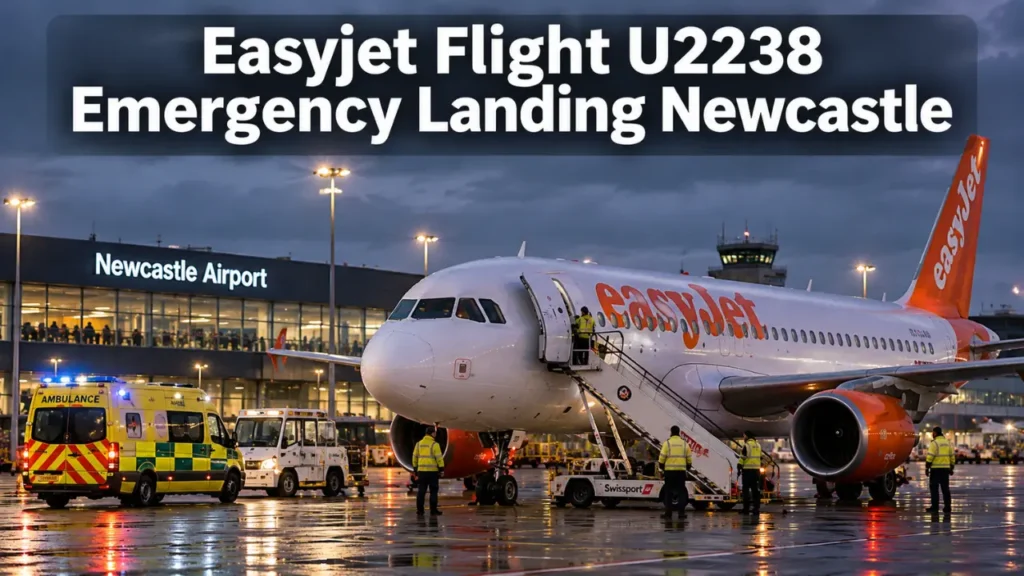
The incident happened on Monday, October 27, 2025. According to contemporary aviation reporting, U22238 departed Copenhagen for Manchester, but the crew declared an emergency while the aircraft was over the North Sea. The reported reason was a passenger welfare issue rather than a confirmed aircraft failure. The Airbus A320 subsequently diverted to Newcastle, where it landed safely and medical personnel took over the situation.
For anyone following the easyjet flight u2238 emergency landing newcastle story, that is the key fact to establish from the beginning: the incident was real, but the commonly searched flight number needs to be distinguished from the actual U22238 flight involved.
What happened during the Copenhagen to Manchester flight?
The aircraft departed Copenhagen Airport on the evening of October 27, 2025, bound for Manchester. It was operating as easyJet U22238, with the aircraft identified as an Airbus A320-214 registered G-EZPB. The flight was already behind its scheduled departure time when it left Copenhagen.
During the journey across the North Sea, a passenger developed a welfare or medical problem that required urgent attention. Rather than continue toward Manchester, the crew declared an emergency and changed course for Newcastle.
That decision was practical rather than dramatic. When a passenger needs urgent medical care during a flight, reaching an airport where appropriate assistance can be provided may take priority over maintaining the original destination.
The aircraft eventually approached Newcastle Airport and landed on runway 25 at about 22:52 GMT, according to the contemporary aviation report. Paramedics then attended the aircraft.
This sequence is central to understanding the easyjet flight u2238 emergency landing newcastle reports that appeared afterward.
Why did the flight divert to Newcastle?
The available reporting points to a passenger welfare issue as the reason for the diversion.
That detail is more important than speculation about technical problems. There is no reliable evidence in the primary incident reporting used here that the aircraft suffered an engine failure, lost control or experienced a catastrophic mechanical problem.
easyJet’s reported explanation was that the flight had been diverted because of a passenger welfare issue. Contemporary reporting also described the incident as a medical emergency onboard.
For an airline crew, a medical emergency can justify changing the destination even when the aircraft itself is operating normally. The goal is to reach a suitable airport quickly enough for the passenger to receive the necessary assistance.
That appears to be what happened in Newcastle.
Was the aircraft in serious danger?
There is a major difference between an aircraft emergency and an aircraft being on the verge of an accident.
The crew declared an emergency, but that declaration does not establish that the aircraft itself was suffering a critical mechanical failure. In this case, the available reporting connects the emergency with a passenger welfare situation.
Flight-tracking data showed the aircraft using the 7700 emergency transponder code. That code indicates a general emergency situation to air traffic control, but it does not identify the exact reason for the emergency.
Consequently, seeing an emergency code on a flight-tracking map should not be treated as proof that an engine failed or that the aircraft was about to crash.
The easyjet flight u2238 emergency landing newcastle story makes much more sense when the emergency declaration is considered alongside the reported passenger medical situation.
The flight number confusion explained
This is where the story becomes particularly interesting.
The flight involved in the October 27 diversion was U22238, not the separate U2238 service.
The contemporary aviation report identifies the flight as U22238 and describes it as the Copenhagen to Manchester service.
By comparison, flight-history information for U2238 shows a Newcastle to Bristol service. easyJet’s own timetable also lists Flight 238 between Newcastle and Bristol.
The similarity between the numbers can easily create confusion.
U22238 can also appear as EZY2238 in aviation tracking because easyJet uses different airline identifiers in different systems. That makes it possible for readers to encounter slightly different versions of the same flight identification.
But U2238 should not simply be substituted for U22238.
That distinction is especially important for the easyjet flight u2238 emergency landing newcastle search because a reader may assume that every result using U2238 is referring to the same flight.
It is not.
What aircraft was involved?
The aircraft involved in the diversion was an Airbus A320-214 registered G-EZPB, according to the contemporary aviation report.
The aircraft type itself is not evidence of a problem.
An Airbus A320 is a common short- and medium-haul passenger aircraft, and the available reporting does not connect the aircraft type with the reason for this particular diversion.
The useful identification is the combination of flight number, route, date and aircraft registration. Those details make it possible to distinguish the Copenhagen to Manchester service from the separate Newcastle to Bristol U2238 operation.
That is why accurate flight identification matters when discussing the easyjet flight u2238 emergency landing newcastle incident.
What happened when the aircraft reached Newcastle?
The aircraft landed safely at Newcastle Airport at approximately 22:52 GMT. The aviation report states that it landed on runway 25 and then taxied to the gate, where paramedics took over the situation.
The landing itself was therefore not reported as a crash or uncontrolled event.
The purpose of diverting to Newcastle was to get the passenger the required medical assistance as quickly as practical.
That also explains why the aircraft did not simply remain in Newcastle indefinitely. Once the immediate situation had been dealt with and the aircraft was ready to continue, the flight resumed its journey.
Did the flight eventually reach Manchester?
Yes.
The aircraft resumed the journey after the Newcastle stop and reached Manchester shortly after midnight on October 28, 2025. Contemporary reporting states that the flight continued for approximately 26 minutes after departing Newcastle and landed at Manchester at about 00:28 GMT.
That detail is easy to overlook, but it provides useful context.
The flight’s final destination remained Manchester. Newcastle was the emergency diversion airport, not the planned destination.
The aircraft therefore followed a straightforward sequence: Copenhagen departure, passenger emergency, emergency declaration, diversion to Newcastle, medical assistance and continuation to Manchester.
That sequence should remain at the heart of any accurate account of easyjet flight u2238 emergency landing newcastle.
Why an emergency diversion does not automatically mean an aircraft failure
Emergency aviation reports often produce alarming headlines because the word “emergency” immediately attracts attention.
But the word covers a broad range of situations.
An aircraft may declare an emergency because of a medical problem involving a passenger, a technical issue, weather conditions, smoke or another situation requiring immediate assistance. The emergency declaration itself does not tell people watching from the ground which category applies.
In the Newcastle case, the available reporting specifically identifies the passenger welfare situation as the reason for the diversion.
That makes it inappropriate to turn the incident into a story about an engine failure or other mechanical crisis without evidence.
The aircraft landed safely and later continued to Manchester. Those facts are much more useful than speculation.
What does squawk 7700 tell us?
The 7700 transponder code is one of the details that caused interest around the flight.
When an aircraft sets 7700, it signals a general emergency condition to air traffic control. This allows controllers and other aviation systems to recognize that the aircraft needs priority attention.
However, 7700 does not function as a detailed explanation of the problem.
A person watching the flight online might see the code and immediately assume that the aircraft is suffering a severe technical malfunction. That conclusion cannot be drawn from the code alone.
In this case, the reported passenger welfare emergency provides the context behind the emergency declaration.
This is another reason why easyjet flight u2238 emergency landing newcastle should be discussed using verified details rather than relying only on flight-tracking screenshots.
Did another aircraft have to wait?
The emergency diversion also affected traffic around Newcastle.
Contemporary reporting stated that Air France flight AFR1558 was held in a holding pattern while the easyJet aircraft completed its approach and the runway was cleared.
That is an understandable part of handling an aircraft that has declared an emergency.
When an aircraft needs priority handling, air traffic control can adjust the movement of other aircraft so the emergency flight has the clearest possible route to landing.
For passengers on other aircraft, that may mean a short delay or holding pattern.
In this case, the Air France flight was among the traffic affected while the easyJet aircraft arrived at Newcastle.
What did easyJet say about the incident?
easyJet described the diversion as being caused by a passenger welfare issue.
The airline’s reported response also emphasized that the passenger was met by medical services after arrival and that the flight later continued to Manchester.
That statement is consistent with the operational sequence reported by aviation sources.
It also reinforces an important point: the airline did not present the incident as a crash or major aircraft failure.
For readers researching easyjet flight u2238 emergency landing newcastle, the airline’s explanation is therefore more useful than unsupported claims about what might have happened onboard.
Why the U2238 mistake keeps appearing
The confusion is understandable because easyJet’s airline code is U2 and the relevant flight number was 2238.
When identifiers are displayed in different formats, readers can encounter versions such as U22238 and EZY2238. A shortened reference can easily become U2238, particularly in headlines or informal discussions.
But the separate U2238 service creates a real distinction.
Current flight-history information lists U2238 as Newcastle to Bristol, while easyJet’s timetable lists Flight 238 on that same route.
That means an article should not state that U2238 itself flew from Copenhagen to Manchester and diverted to Newcastle.
The more accurate wording is that the widely searched easyjet flight u2238 emergency landing newcastle incident involved easyJet U22238/EZY2238.
That small correction makes the reporting considerably more reliable.
What passengers can learn from the diversion
The incident shows why airline crews sometimes abandon an otherwise normal flight plan.
A passenger emergency can happen without warning. Once it becomes clear that urgent medical assistance is needed, reaching a suitable airport can become more important than maintaining the original route.
Passengers should also be cautious about interpreting what they see on flight-tracking websites.
A sudden turn, an emergency code or an unexpected landing does not reveal the full situation inside the cabin. The crew has information that people watching from the ground do not have.
The Newcastle diversion demonstrates that point clearly.
From outside the aircraft, the event looked like an unusual change of route. From an operational perspective, it was a crew decision to get a passenger to medical assistance as quickly as possible.
The real story behind the Newcastle landing
The most accurate account is straightforward.
On October 27, 2025, easyJet flight U22238 was travelling from Copenhagen to Manchester when a passenger required urgent medical attention. The crew declared an emergency and diverted the Airbus A320 to Newcastle. The aircraft landed safely, medical personnel attended to the passenger, and the aircraft later continued to Manchester.
The biggest complication is the flight number.
U2238 is a separate Newcastle to Bristol service. The October 2025 emergency flight was U22238/EZY2238.
That difference should remain clear because getting the flight number wrong can make an otherwise accurate aviation report point readers toward the wrong aircraft and route.
The easyjet flight u2238 emergency landing newcastle story is therefore best understood as a case of a real emergency diversion being widely associated with a shortened or confused flight number.
Final takeaway
The Newcastle incident was serious because a passenger needed urgent medical attention, but the available evidence does not support turning it into a story about a crashing or catastrophically damaged aircraft.
The aircraft landed safely, medical assistance was provided and the journey eventually continued to Manchester. The crucial correction is that the diverted service was U22238/EZY2238, while U2238 is a separate Newcastle to Bristol flight.
For anyone searching easyjet flight u2238 emergency landing newcastle, the lesson is simple: check the complete flight identifier before accepting the headline. In aviation reporting, one missing digit can change the route, the aircraft and the entire story.
FAQs
1. Was U2238 the flight that diverted to Newcastle in October 2025?
No. The October 27, 2025 diversion involved U22238, also identified as EZY2238. U2238 is a separate easyJet service between Newcastle and Bristol.
2. What happened to the passenger after the aircraft landed?
The available reporting confirms that medical services met the passenger after the aircraft reached Newcastle. The passenger’s detailed medical condition was not publicly established in the strongest contemporary reporting, so it is better not to speculate about a diagnosis.
3. Did the aircraft continue flying after the Newcastle diversion?
Yes. After the diversion and medical response, the aircraft resumed its journey and arrived at Manchester at approximately 00:28 GMT on October 28.
4. Does squawk 7700 prove that the aircraft had a mechanical failure?
No. Squawk 7700 indicates a general emergency situation but does not identify the specific cause. In this incident, contemporary reporting associated the emergency with a passenger welfare issue.
5. Why is the incident sometimes described as an U2238 emergency?
The numbers are very similar, and U22238/EZY2238 can be displayed differently across aviation systems and reports. The separate U2238 service makes the distinction important: the Copenhagen to Manchester emergency flight was U22238/EZY2238, not the Newcastle to Bristol U2238 service.