
Introduction
A good tarp earns its place in outdoor gear by solving a real problem. It should keep equipment protected, provide useful shelter, handle bad weather, and remain practical to carry and set up. With tarnplanen, there is an additional consideration: the cover should fit naturally into its surroundings rather than becoming the most noticeable object in the area.
That combination makes camouflage tarps useful well beyond one particular activity. Campers can use them for shelter and rain protection, photographers can use them around outdoor observation setups, and homeowners can use them to cover equipment or materials. But not every camouflage tarp deserves the same level of trust. Fabric quality, construction, size, attachment points, and weather resistance make a much bigger difference than an attractive camouflage print.
What Makes tarnplanen Different From an Ordinary Tarp?
The main distinction is the combination of covering and camouflage. A standard tarp is usually chosen for protection from rain, dust, sunlight, or general outdoor exposure. A tarnplanen adds a camouflage pattern intended to make the covered object or shelter less visually prominent in its surroundings.
The German roots of the word are also straightforward. “Tarn” relates to camouflage or concealment, while “Planen” refers to tarpaulins or covers. In practical English usage, the closest description is camouflage tarp or camouflage tarpaulin. Current sources consistently use the term in this practical outdoor context.
The camouflage itself should not be treated as magic. A tarp does not become invisible simply because it has a woodland pattern. Its effectiveness depends on the landscape, colors, lighting, shape, movement, and placement.
That is why a good tarnplanen should be judged as outdoor equipment first and camouflage equipment second.
Material Choice Determines How the Tarp Performs
The fabric is one of the first things worth checking because it affects weight, durability, water resistance, flexibility, and storage.
Polyester and Nylon
Polyester and nylon are common choices for lightweight outdoor tarps. They can be easier to carry than heavier canvas and are suitable for camping or situations where equipment needs to be packed and transported regularly.
Nylon is particularly useful when low weight matters. Polyester can also offer a practical balance between weight and durability, depending on how it is woven and treated.
Coatings can change their performance considerably. Polyurethane and PVC coatings are used on some outdoor fabrics to improve resistance to moisture and increase protection against outdoor conditions.
Canvas and Cotton-Blend Fabrics
Canvas takes a different approach. It is heavier and has a more substantial feel, making it useful where toughness and long-term outdoor use are more important than keeping pack weight low.
The disadvantage is obvious when carrying equipment over a long distance. A heavy canvas tarp can become inconvenient quickly. It may also require more attention when wet because untreated or insufficiently treated canvas can absorb moisture.
For a fixed outdoor cover, that extra weight may be acceptable. For backpacking, it may not be.
Ripstop Construction
Ripstop fabric is worth considering when a tarp will be folded, transported, pitched, and exposed to rough outdoor surfaces repeatedly. Its reinforced weave is designed to limit the spread of small tears.
It is not a guarantee against damage. Sharp branches, rough ground, excessive tension, and careless handling can still damage the fabric. But construction quality can determine whether a small problem remains manageable or becomes a major failure.
Waterproofing Should Be Judged by the Whole Construction
Calling a tarp waterproof tells only part of the story.
The fabric needs to resist water, but seams, hems, corners, coatings, and attachment points also matter. A strong waterproof material can still perform poorly if water enters through weak seams or if the tarp is installed in a way that allows water to collect.
A good tarnplanen should therefore be considered in relation to the conditions in which it will be used.
For occasional camping in light rain, a lightweight weather-resistant tarp may be perfectly adequate. For repeated exposure to heavy rain, a more substantial construction and properly protected seams become more important.
The setup also matters. A tarp should normally be positioned so water can run away rather than sit in a low section. Standing water adds unnecessary weight and tension to the fabric.
Water resistance is a product feature. Good setup is a user responsibility.
Camouflage Patterns Should Match the Surroundings
There is little value in choosing a camouflage pattern simply because it looks impressive in a product photograph.
Woodland patterns make obvious sense around forests and areas dominated by green and brown vegetation. Desert-style designs suit dry, sandy, or rocky landscapes better. Gray or muted patterns may make more sense around certain built environments.
Digital camouflage uses smaller blocks or pixel-like shapes to create a broken visual pattern. Whether it works better than a traditional pattern depends entirely on the environment.
A tarnplanen should therefore be selected according to where it will actually be used.
A woodland pattern in an open sandy environment can stand out more than a plain earth-colored cover. Likewise, a dark pattern can look unnatural in a bright landscape.
Camouflage works through context. The environment always has the final say.
Where tarnplanen Is Most Useful
Camouflage tarps have a wide range of ordinary outdoor applications.
Camping and Temporary Shelter
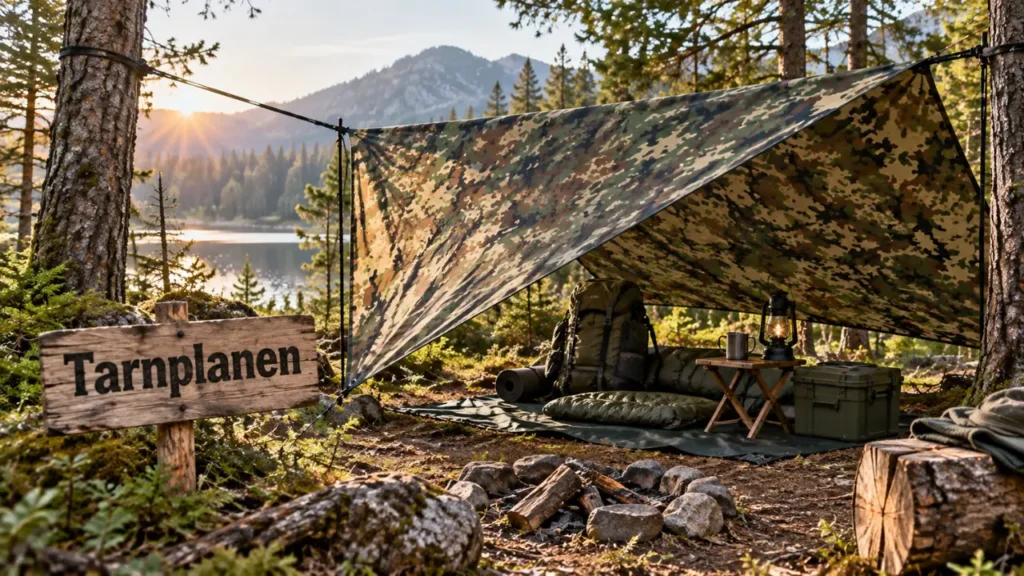
Camping is one of the most practical uses. A tarp can provide overhead rain protection, create a windbreak, cover equipment, or form part of a simple outdoor shelter.
The main advantage is flexibility. One tarp can be configured differently depending on the weather and available space.
For campers, weight becomes especially important. A tarp that is easy to pack and quick to pitch is usually more useful than an extremely heavy model that stays in the vehicle because nobody wants to carry it.
Wildlife Photography and Outdoor Observation
Wildlife photographers often need equipment that does not dominate the surrounding landscape. A muted camouflage cover can help reduce the visual contrast of equipment.
The important point is that camouflage does not guarantee that wildlife will fail to notice a person or object. Animals respond to movement, sound, smell, and changes in their surroundings as well as visual appearance.
A tarnplanen can be useful as part of a considerate outdoor observation setup, but it should not be treated as a substitute for responsible wildlife practices.
Garden and Household Protection
The same basic tarp can have a much less adventurous job at home.
Outdoor furniture, gardening equipment, tools, firewood, and other items may need temporary protection from rain, dust, and sunlight. In these situations, camouflage may be a matter of preference rather than necessity.
If visual concealment is irrelevant, there is little reason to pay extra for a camouflage design. A standard protective tarp may do exactly the same practical job.
Outdoor Work and Equipment Covers
Construction, maintenance, gardening, and other outdoor projects can create situations where materials need temporary protection.
A camouflage cover can be useful when appearance matters, but durability and dimensions should come first. A cover that is too small, too thin, or poorly reinforced will not become better equipment because of its pattern.
The Attachment System Is More Important Than It Looks
Eyelets and grommets are easy to ignore when shopping because they occupy only a small part of the tarp.
They should not be ignored.
These attachment points transfer tension from ropes, cords, stakes, or other fastening systems into the fabric. If they are poorly reinforced, repeated setup can damage the edges even when the main fabric remains in good condition.
Look for reinforced corners and edges. Check whether the eyelets appear securely integrated into the material rather than simply pressed into a weak section of fabric.
The number and position of attachment points also affect versatility. More secure points can make it easier to create different shelter shapes or cover irregular equipment.
A well-made tarnplanen should be strong at the points where it is actually handled and secured, not just in the middle of the sheet.
Choosing the Right Size Without Overbuying
Size sounds simple until the tarp is actually pitched.
A tarp loses usable coverage when it is angled, folded, or stretched into a shelter configuration. A sheet that looks enormous when laid flat may provide considerably less protected space once installed.
Start with the job.
If the goal is to cover a backpack and sleeping area, a compact tarp may be sufficient. If the goal is to protect several pieces of equipment, additional surface area becomes more useful. Covering a vehicle or a large pile of outdoor materials requires another size category altogether.
There is a downside to going too large.
A very large tarp can be harder to tension and more difficult to manage in strong wind. It may also require more attachment points and more space for setup.
The best tarnplanen is not necessarily the largest one available. It is the one that provides enough coverage without becoming awkward to handle.
Weight Matters When You Have to Carry It
A tarp can look excellent on a specification sheet and still be the wrong choice once it is inside a backpack.
Lightweight users should pay attention to fabric thickness, total weight, packed size, and the hardware included with the tarp. Heavy-duty materials can provide additional durability, but that advantage has to be weighed against portability.
For vehicle-based camping, weight is less restrictive. For hiking, every additional item competes for limited space.
This is where choosing based on the actual activity becomes important. A heavy tarp may be an excellent equipment cover and a poor backpacking shelter at the same time.
There is no contradiction. Different jobs require different priorities.
UV Exposure Can Affect Long-Term Performance
Rain is easy to notice, but sunlight can quietly damage outdoor equipment over time.
Repeated ultraviolet exposure can contribute to fading and material degradation. This matters most when a tarp remains outdoors for long periods rather than being packed away after every trip.
If a tarnplanen will be used as a seasonal or permanent outdoor cover, UV resistance deserves attention alongside waterproofing.
For occasional camping, this may be a lower priority. For equipment that stays outside throughout the summer, it can become a major consideration.
The expected exposure should influence the purchase.
How to Look After a Camouflage Tarp
Good maintenance does not require complicated equipment.
After use, remove dirt and debris without unnecessarily aggressive scrubbing. Follow the manufacturer’s care instructions if the fabric has a special coating.
Most importantly, do not pack the tarp away while it is wet.
Allow it to dry fully before folding or storing it. Moisture trapped inside folded material can create unpleasant odors and may contribute to mildew problems depending on the fabric and storage conditions.
Before storing it for a long period, inspect the corners, seams, eyelets, and surface for damage.
A small tear is easier to deal with before the next trip than when the tarp is already stretched tightly over a shelter.
Common Buying Mistakes to Avoid
The biggest mistake is choosing a tarp because the camouflage pattern looks good.
The second is assuming every product described as waterproof has identical water resistance. Product construction varies, and the intended use matters.
Another common mistake is ignoring the weight. A tarp that is unnecessarily heavy can become a burden on longer trips.
Buying the wrong size is also expensive. Too small means inadequate coverage. Too large can mean unnecessary weight and more difficult setup.
Finally, do not ignore the attachment points. Strong fabric cannot compensate for weak corners or poorly secured grommets.
A practical buying order is simple: intended use, material, size, construction, weather resistance, attachment points, weight, and then appearance.
When a Standard Tarp Makes More Sense
Camouflage is not automatically better.
If you are covering garden furniture, protecting building materials, or placing a temporary cover over equipment in your backyard, a regular tarp may provide everything you need.
The camouflage pattern becomes valuable when blending with the surrounding environment is actually useful. If that feature has no practical purpose, spending more for it may not make sense.
That is an important distinction because good outdoor gear should solve a problem rather than create a reason to buy another feature.
For some users, tarnplanen will be exactly the right product. For others, a conventional tarp will be the more sensible choice.
The Practical Way to Choose tarnplanen
Start with the environment and the job, not the product photograph.
For lightweight camping, look toward portable synthetic fabrics and a manageable packed size. For stationary outdoor coverage, heavier construction may be preferable. If rain is a serious concern, examine waterproofing, seams, coatings, and the quality of the edges rather than relying on a single marketing label.
Then consider the camouflage pattern. Choose one that belongs visually in the environment where it will actually be used.
Finally, inspect the details that are easy to overlook: reinforced corners, grommets, stitching, weight, dimensions, and storage requirements.
That process eliminates most poor choices before price even becomes the deciding factor.
Final Takeaway
The best tarnplanen is not the one with the most impressive camouflage or the longest list of features. It is the one that survives the conditions you bought it for and remains easy enough to use when the weather changes or the setup needs to move.
Treat the tarp as equipment, not decoration. Check the fabric, reinforcement, size, weight, waterproofing, and attachment system first. Then choose the camouflage pattern that fits the environment.
That approach leads to a simple conclusion: buy the tarp for the job, and let the camouflage be the advantage rather than the selling point.
FAQs
1. Can tarnplanen be used as a groundsheet?
Yes, provided the material and construction are suitable for ground contact. Remove sharp stones and branches first because repeated abrasion can damage even durable tarp fabric.
2. Should a camouflage tarp be left folded while wet?
No. It should be dried thoroughly before storage. Keeping damp fabric folded for extended periods can lead to odors and mildew-related problems.
3. Is a heavier tarp always more durable?
No. Weight alone does not determine durability. Fabric construction, coating, stitching, reinforcement, and the quality of the eyelets all influence how well a tarp handles repeated outdoor use.
4. How do I know what size tarp I actually need?
Measure the area you need to cover and account for the shape you intend to create. A tarp used as an angled shelter provides less horizontal coverage than its flat dimensions suggest.
5. What should I inspect before buying a camouflage tarp?
Check the material, dimensions, total weight, waterproofing claims, reinforced edges, corners, eyelets, stitching, and intended outdoor use. The camouflage pattern should come after these practical factors, not before them.