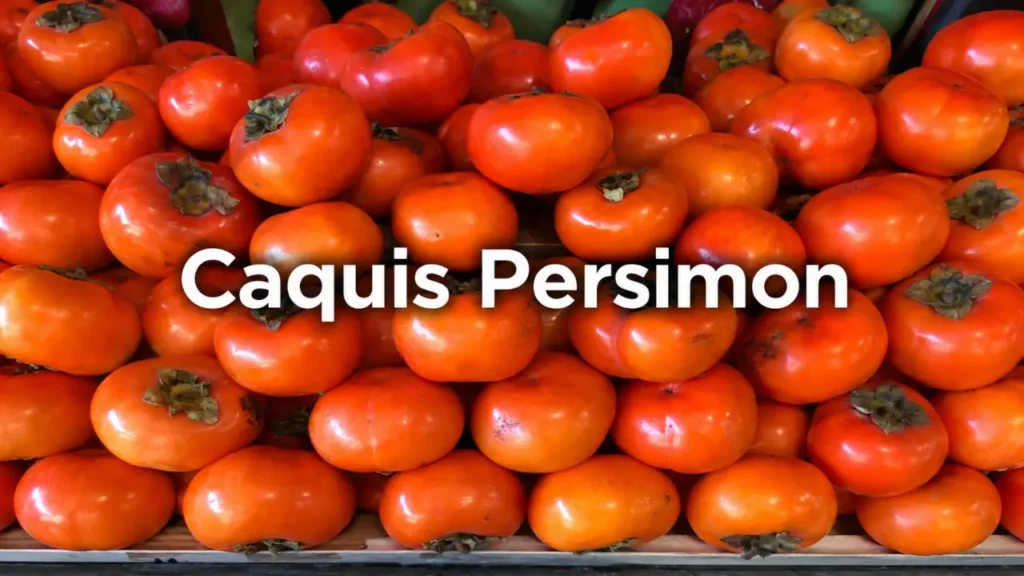

Introduction
A persimmon can be one of the sweetest fruits on the market or one of the most unpleasant things to bite into, and the difference usually comes down to variety and ripeness. That is especially true with caquis persimon, where a firm orange fruit can be ready to eat even though a traditional astringent persimmon may need to become extremely soft first. Once that distinction is clear, buying and eating caqui fruit becomes much easier.
The confusion is understandable. Persimmons appear under different names in different markets, and their texture can range from crisp to almost jelly-like. Caquis fruit can also look ready before it actually is, particularly when the variety contains soluble tannins responsible for astringency. The best way to judge the fruit is therefore not by color alone, but by knowing what type you have purchased.
Why caqui fruit has such different textures
The most important fact about caqui fruit is that persimmons do not all behave the same way.
Persimmon varieties are commonly separated into astringent and non-astringent groups. Fuyu, Jiro and Izu are examples of non-astringent varieties, while Rojo Brillante and Hachiya are examples of astringent varieties. Soluble tannins in astringent fruit can interact with proteins in saliva, producing the dry, rough sensation people notice when an underripe persimmon is eaten.
That explains an experience that surprises first-time buyers.
A person may purchase caquis fruit expecting something crisp and sweet, take a bite while it is still firm, and immediately wonder what went wrong. If the fruit is an astringent variety, nothing has necessarily gone wrong. It simply has not reached the right eating stage.
Non-astringent varieties are much more forgiving. They can often be eaten while firm, giving the fruit a clean crunch that works well for fresh snacking.
Caquis persimon is closely linked to Rojo Brillante
Caquis persimon has a particularly interesting story because Persimon is not simply another name for every persimmon sold in stores.
The official Kaki Ribera del Xúquer organization identifies Persimon® as a registered mark used for Rojo Brillante persimmons from the protected designation area in Valencia, Spain. The fruit is treated to remove its natural astringency while retaining a firm, crisp flesh.
That distinction matters.
Rojo Brillante is naturally an astringent variety. Traditionally, it was eaten after becoming very ripe, when its flesh turned soft and almost gelatinous. The development of deastringency methods created another way to enjoy the same variety: firm, orange-colored and crisp.
So a firm caquis persimon is not necessarily an underripe persimmon.
In fact, firmness is part of the appeal.
The difference between traditional and firm Rojo Brillante
Rojo Brillante demonstrates why appearance alone can be misleading.
In its traditional form, the fruit is allowed to mature until the flesh becomes soft. It can then be eaten with a spoon because the texture is exceptionally tender.
The Persimon® form takes a different route. After harvest, the fruit undergoes a controlled deastringency process. The unpleasant tannic sensation is removed while the flesh remains firm enough to slice. The official product information describes this version as orange, firm and crisp.
This gives consumers two very different experiences from the same variety.
One is soft and almost spoonable.
The other is firm enough to cut with a knife.
That is one of the most interesting facts about caqui fruit and one of the easiest points to get wrong in a generic persimmon article.
What causes the dry sensation in caquis fruit?
The mouth-drying sensation associated with an underripe persimmon comes primarily from soluble tannins.
It is important not to confuse astringency with sourness. Astringency is a tactile sensation rather than simply a taste. It can make the mouth feel rough or dry even when the fruit itself has a noticeable sweetness.
Research on Rojo Brillante describes soluble tannins as being responsible for the rough, dry sensation associated with astringent persimmons.
As the fruit reaches the appropriate stage or undergoes a deastringency treatment, those tannins become less available to produce the sensation.
This is why an underripe astringent caqui fruit can seem almost impossible to enjoy, while the same type of fruit at the right stage can be remarkably sweet.
The main caqui fruit varieties worth knowing
You do not need a long list of obscure cultivars to shop intelligently. A few familiar examples cover the most useful differences.
Fuyu
Fuyu is one of the best-known non-astringent persimmons. It is usually squat and rounded, and its firm flesh makes it convenient for fresh eating.
If you want a persimmon that behaves more like a crisp snack fruit, Fuyu is a sensible choice.
Hachiya
Hachiya is an astringent variety with a more elongated shape. It is a poor candidate for eating while hard because its tannins can create a powerful drying sensation.
Wait until the flesh becomes very soft.
Rojo Brillante
Rojo Brillante is especially important when discussing caquis persimon. It is a major commercial variety in Spain and is associated with the Ribera del Xúquer region. Research describes it as an astringent cultivar with a pointed or oblong shape, large fruit and sweet flesh once properly prepared for consumption.
When its astringency is removed, it can be sold as Persimon® with firm, crisp flesh.
How to tell whether caqui fruit is ready to eat
The correct test depends on the variety.
With a non-astringent fruit such as Fuyu, firmness is not a warning sign. A crisp texture can be exactly what you want.
With a traditional Hachiya, firmness is a reason to wait. The fruit should become very soft before it is eaten.
With caquis persimon carrying the Persimon® designation, firm flesh is expected because the fruit has been prepared for consumption without requiring the soft, overripe texture associated with traditional Rojo Brillante.
This makes the label and variety more useful than a simple squeeze test.
Color also has limits as a ripeness guide. Research on Rojo Brillante has specifically examined maturity assessment because external appearance does not tell the whole story.
What caquis persimon tastes like
A good caquis persimon has a sweet flavor with a firm, crisp bite. That texture is what makes it particularly convenient for slicing.
It can be eaten directly, cut into wedges or added to dishes where soft fruit would fall apart.
Traditional ripe Rojo Brillante is completely different. Its flesh becomes soft and gelatinous, producing a richer mouthfeel that suits spoon eating and desserts.
The contrast is worth remembering: the difference between the two is not necessarily a difference in fruit variety. In the case of Rojo Brillante, it can be a difference in how the fruit has been prepared for eating.
Caqui fruit nutrition deserves a realistic look
Caqui fruit has useful nutritional qualities without needing exaggerated health claims.
Persimmons contain dietary fiber, vitamin C, carotenoids and minerals such as potassium. Research on deastringed Rojo Brillante has also examined compounds including sugars, carotenoids and phenolic compounds.
A medium Japanese persimmon is also a meaningful source of dietary fiber and vitamin C, although nutritional values vary with fruit size and variety.
The practical advantage is simple: caquis fruit can add sweetness and fiber to ordinary meals without requiring elaborate preparation.
A sliced persimmon can go into breakfast, a salad or a snack. A softer fruit can be used in desserts or blended preparations.
There is no need to turn it into a miracle food.
The easiest ways to eat caquis fruit
Firm caquis fruit is arguably the easiest version to use in everyday meals.
Wash it, remove the stem, slice it and eat it fresh. Depending on the variety and personal preference, the skin can also be eaten.
Firm slices hold their shape well, which makes them useful in salads. They can add sweetness alongside leafy greens, nuts and sharper dressings.
Caquis persimon is particularly convenient for fruit platters because its crisp flesh can be cut into neat pieces without collapsing.
Soft ripe persimmons call for a different approach. Once an astringent variety has reached its proper stage, the flesh can be scooped out and eaten directly or incorporated into desserts.
The texture should dictate the recipe.
Why the skin does not need to be automatically removed
The skin of an edible persimmon can be eaten after the fruit has been washed properly.
With firm varieties, keeping the skin can make preparation quicker and preserve the fruit’s structure. With very soft caqui fruit, removing the skin may be less convenient than simply cutting the fruit and scooping out the flesh.
There is no universal rule requiring the skin to be discarded.
What matters more is the condition of the fruit and the preferences of the person eating it.
How to store caquis fruit at home
Storage should match the fruit’s stage of ripeness.
Firm caquis fruit can be kept at room temperature while you wait for the desired eating stage, depending on the variety. Soft ripe fruit needs more careful handling because its flesh can bruise easily.
The official Persimon® guidance recommends room-temperature storage for its firm Rojo Brillante product.
Do not pile heavy fruit on top of soft persimmons. A ripe fruit can deteriorate quickly when repeatedly pressed against another piece of produce.
If you have both firm and soft fruit, separate them and use the softer pieces first.
Caquis persimon in Spanish agriculture
The Spanish connection gives caquis persimon a story that goes beyond supermarket branding.
Rojo Brillante originated in the Ribera Alta area of Valencia through a spontaneous mutation of another local variety, Cristalino, according to the Kaki Ribera del Xúquer organization. The variety is described as oblong and large, with availability typically running from October into January.
The commercial development of deastringency changed how this fruit could be sold and eaten.
Instead of requiring consumers to wait for an extremely soft fruit, producers could offer firm flesh that was ready to eat.
That was commercially important because soft fruit is harder to handle, transport and present in good condition. Research on Rojo Brillante notes that natural loss of astringency through overripening leaves the fruit soft and difficult to handle.
The firm version solves a practical problem as much as a culinary one.
Common mistakes when buying caqui fruit
The first mistake is assuming that every persimmon should be firm.
That is wrong for traditional astringent varieties.
The second mistake is assuming that every firm fruit is unripe.
That is also wrong.
A Fuyu can be firm and ready. A properly prepared caquis persimon can be firm and ready. A hard Hachiya may need considerable additional ripening.
The third mistake is judging the fruit entirely by color. Color can be useful, but it cannot tell you whether a particular variety is astringent or whether its tannins have been removed.
Finally, do not assume Persimon® is simply a generic spelling variation for persimmon. The official designation identifies a particular commercial presentation of Rojo Brillante associated with the Kaki Ribera del Xúquer PDO.
Choosing the right persimmon for the way you eat
If you want something crisp that can be sliced immediately, look for a non-astringent variety or a properly prepared caquis persimon.
If you prefer soft fruit with a spoonable texture, choose an astringent variety and give it enough time to mature.
If you are preparing a salad, firm caqui fruit is the better choice because it maintains its shape.
If you are making a soft dessert, very ripe astringent fruit may be more useful because its texture naturally breaks down.
The best choice is not about which variety is universally superior. It is about matching the fruit to the eating experience you want.
FAQs about caquis fruit
1. Can a firm persimmon be sweet?
Yes. Non-astringent varieties can be sweet while remaining firm. Properly prepared Persimon® Rojo Brillante is also sold with firm, crisp flesh and is intended to be ready to eat.
2. Why does one caqui fruit need to become soft while another can stay crunchy?
The difference usually comes from the variety and its astringency. Astringent varieties contain soluble tannins that create the dry sensation when eaten too early, while non-astringent varieties can be eaten while firm.
3. Is Persimon® a different species from persimmon?
No. In the Spanish context, Persimon® is a registered commercial mark associated with Rojo Brillante persimmons from the Kaki Ribera del Xúquer PDO after deastringency treatment.
4. Can I use caquis persimon in a salad?
Yes. Its firm, crisp texture makes it particularly suitable for slicing into salads, fruit plates and other dishes where you want the pieces to retain their shape.
5. What should I do if caquis fruit tastes extremely dry?
First, check whether you have an astringent variety. If the fruit is naturally astringent and still firm, it may simply need more ripening. Eating a properly prepared non-astringent variety or Persimon® product avoids that problem.