
Introduction
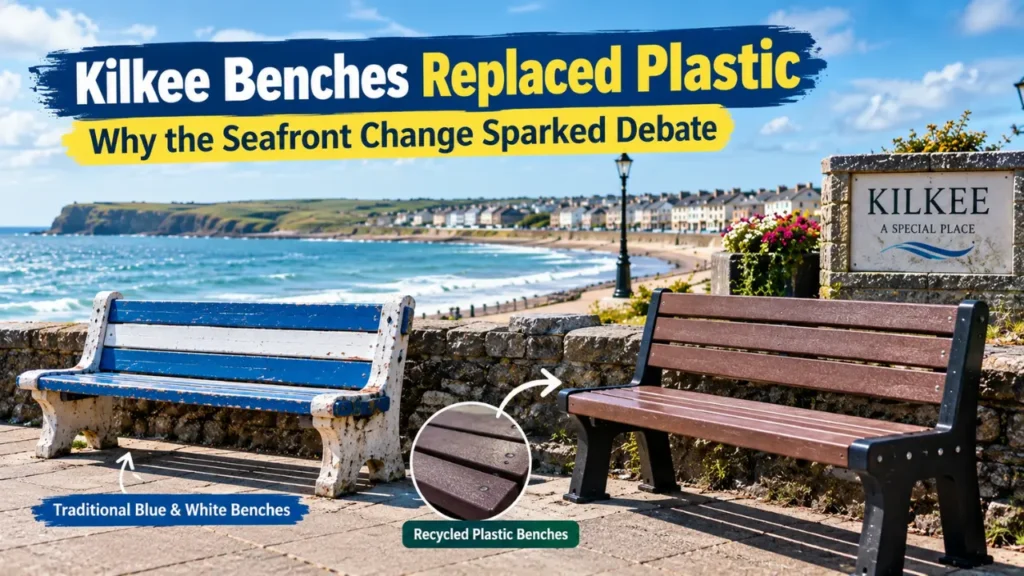
Kilkee did not expect a dispute over public benches to become a talking point, but the replacement of its familiar blue-and-white wooden seats with brown recycled-plastic benches quickly drew attention. The change was visible across parts of the west Clare seaside town, and for residents who had known the traditional benches for decades, it was not simply a matter of swapping one type of street furniture for another.
The story behind kilkee benches replaced plastic is more complicated than a simple argument against plastic. Clare County Council has pointed to health and safety as the basis for replacing benches when the need arises, while residents questioned the loss of a distinctive feature of Kilkee’s seafront. Local reporting in June 2025 estimated that about 20 of the traditional seats had already been removed, including benches around the Esplanade, the old Strand Hotel area, George’s Head car park and the Kilkee Bandstand.
What makes the issue worth following is the clash between two reasonable priorities. Public furniture needs to be safe and durable, but a seaside town also has a visual identity. Kilkee’s old benches had become part of that identity long before anyone started debating their replacement.
The old Kilkee benches were more than ordinary street furniture
The traditional Kilkee benches were distinctive because of their blue-and-white paintwork. According to local reporting, those colours were connected with Kilkee’s GAA identity, giving the benches a local character that a standard commercial seat would not have. They had also been a familiar feature along the seafront for decades.
That history explains why the reaction was stronger than the council might have expected from an ordinary maintenance project.
A bench beside a promenade is easy to overlook when it is new. After years of use, however, it becomes part of the scenery. Residents know where particular benches are positioned. Visitors photograph them without necessarily thinking about them. Families may remember sitting on them during summer trips. Local people can associate their colours with the town before they consciously realise it.
This is one reason kilkee benches replaced plastic became a local talking point. The change was immediately visible, particularly because brown replacement benches looked noticeably different from the blue-and-white seats that had occupied the same public spaces.
The issue was therefore not only about material. It was about familiarity.
Where were the traditional benches removed?
The initial replacements were not limited to one isolated corner of Kilkee.
Local newspaper reporting in June 2025 identified several affected locations. Four benches were removed from the promenade in front of the Esplanade. Another was removed from the green area beside the old Strand Hotel. Several others were taken away from George’s Head car park and the Kilkee Bandstand. The report estimated that approximately 20 original seats had been replaced at that stage.
These are prominent locations rather than hidden back streets.
That matters because public furniture is most noticeable when it sits beside a landmark, a busy promenade or a well-used coastal viewpoint. A replacement seat in a quiet corner might attract little attention. A new bench on the seafront becomes part of the view.
The phrase kilkee benches replaced plastic therefore became closely associated with a highly visible change in the town’s public realm.
Why did Clare County Council replace the benches?
The strongest documented reason was health and safety.
Clare County Council confirmed that there were no plans to remove or replace additional traditional benches until the need arose on health-and-safety grounds. That statement is important because it shows that the council did not describe the project as an across-the-board attempt to eliminate every traditional bench in Kilkee.
There are also practical issues with maintaining old outdoor furniture in a coastal environment.
Kilkee’s benches spend their lives exposed to rain, damp conditions, wind and salt-laden Atlantic air. Timber requires maintenance, and older structures can develop weaknesses that are not obvious simply by looking at the seat from a distance.
Local reporting included comments from a person with construction experience who raised concerns about steel rods used in the older benches and the way expansion could contribute to cracking in concrete. That gives the safety argument more substance than simply saying the council wanted newer furniture.
This is where the discussion needs to stay factual.
It would be wrong to claim that every old bench was dangerous or rotten. In fact, the same June 2025 report observed that many of the remaining traditional benches appeared to be in very good condition. The council’s position was that replacement would occur when it became necessary for health and safety.
That distinction is central to understanding the dispute.
What replaced the blue-and-white seats?
The replacement seats were described by local reporting as brown recycled-plastic benches.
They were not simply ordinary disposable plastic chairs. The material was specifically reported as recycled plastic, and the new benches formed part of the council’s replacement of older public seating.
For a coastal authority, recycled plastic can offer practical advantages. Unlike traditional timber, it does not rot in the same way, and it can reduce the need for certain forms of painting and timber maintenance.
That does not mean the new material is automatically superior in every respect.
A public bench has to be judged on durability, maintenance, appearance, comfort, cost and how well it fits the location. Calling something recycled does not settle all of those questions.
The strongest practical case for the new benches is that councils need public furniture that can withstand outdoor conditions while remaining manageable to maintain.
The strongest criticism is that practical furniture can still look out of place.
Why did the brown colour become part of the controversy?
The colour difference was hard to miss.
The old benches were blue and white. The replacements were brown. That meant the change affected the appearance of the promenade even when the basic function of the bench remained exactly the same.
This is where the kilkee benches replaced plastic debate moved beyond maintenance.
Residents who valued the old benches were not necessarily arguing that wooden furniture should remain regardless of its condition. The stronger argument was that Kilkee could modernise its seating without losing the visual character that made the old benches recognisable.
A replacement can be safer and still be poorly matched to its surroundings.
That is a design question rather than an engineering question.
Public authorities often have to choose standard products because they are easier to source, replace and maintain. But standardisation has a downside. If every town installs identical benches, signs, railings and bins, local differences slowly disappear.
Kilkee’s benches illustrate that problem in a very small and visible way.
The remaining benches changed the picture
The first wave of replacements did not remove every traditional seat.
By late June 2025, The Clare Champion reported that around 30 traditional benches remained in Kilkee, alongside a similar number of new brown plastic benches, excluding picnic benches.
That means the town had a mixture of old and new seating rather than a complete replacement.
This detail matters because it gives the story a future dimension.
The remaining traditional benches will eventually require maintenance. Some may last for years; others may eventually reach a point where repair or replacement is necessary. When that happens, the council will have another opportunity to consider not only what material to use but also what appearance the replacement should have.
The reaction to the first replacements provides useful information.
Residents have shown that the visual identity of the old benches matters to them. The council, meanwhile, has a responsibility to provide safe public facilities.
A future solution could acknowledge both concerns rather than treating them as mutually exclusive.
What did the council’s wider Kilkee works involve?
The bench issue also sits within broader public-realm work in Kilkee.
A Clare County Council chief executive report published in 2025 recorded public-realm works in Kilkee where benches were removed from a sloped grass mound near Nolan’s Hill on Strand Line. The council reported that a new wall and flat reinforced-concrete slab were constructed, with new benches and wheelchair-friendly picnic tables installed.
That detail is useful because it shows that not every bench change was simply a straightforward replacement of one seat with another.
Some work involved changing the surrounding public space as well.
Accessibility is a legitimate consideration in public-realm planning. A flat surface and wheelchair-friendly picnic facilities can make a coastal public area easier for people with mobility needs to use.
This adds another layer to the wider discussion around kilkee benches replaced plastic. Public-space upgrades are not judged only by how traditional they look. They also have to serve the people using them today.
Is recycled plastic actually the better material?
There is no simple yes-or-no answer.
Recycled plastic can make sense for outdoor seating because it is resistant to moisture and does not suffer from timber rot in the same way. It can also require less routine treatment than painted wooden furniture.
For a coastal town such as Kilkee, those characteristics have real value.
But durability is not the only measure.
A bench can last a long time and still be a poor visual fit. Conversely, a beautifully designed traditional bench can become difficult to justify if maintaining it requires repeated repairs or creates safety concerns.
The sensible comparison is therefore not “wood is good” versus “plastic is bad.”
The better question is whether the chosen material provides the required durability while allowing the furniture to respect the character of the location.
That distinction gets lost in simplistic online discussions of the kilkee benches replaced plastic story.
Could Kilkee keep the traditional appearance?
Yes, at least as a design possibility.
The material used for a modern bench does not necessarily determine its colour or visual character. A recycled-plastic seat can potentially be produced in different colours and designs, depending on the product selected.
That does not mean Clare County Council has announced plans to recreate the old blue-and-white benches in recycled plastic. There is no basis for presenting that as an existing council programme.
It is simply the obvious design question raised by the controversy.
If safety and low maintenance are the reasons for replacing the old seats, then a modern bench does not necessarily need to look completely different from its predecessor.
A future replacement programme could potentially consider local colours, traditional proportions or another visual feature that connects new seating with Kilkee’s established appearance.
That approach would not preserve every old bench. It would preserve part of what people recognised about them.
Why the public reaction should not be dismissed
It is easy to mock a dispute about benches.
That would miss the point.
People become attached to places through small details. A town’s identity is rarely created by one monument or one historic building. It comes from the combination of streets, colours, shopfronts, public spaces, views and everyday objects.
Kilkee’s traditional benches were one of those details.
The local reaction also shows that residents can hold two views at once. Someone can accept that an unsafe bench needs to be replaced while still asking why the replacement could not better reflect the town.
That is a reasonable position.
The phrase kilkee benches replaced plastic is therefore useful as a description of a wider civic question: how much should a town change when updating its public spaces?
What Kilkee can learn from the bench controversy
The first lesson is that public consultation matters when a change is highly visible.
Even when an authority has sound technical reasons for replacing something, people are more likely to understand the decision when they know why it is happening.
The second lesson is that design deserves a place alongside safety.
There is no benefit in preserving an unsafe bench simply because it looks traditional. But there is also no rule saying that a safer replacement has to ignore local character.
The third lesson is that “modern” should not automatically mean “generic.”
A seaside town should be able to use durable contemporary materials without making its public spaces look interchangeable with those of every other town.
That may be the most useful takeaway from the kilkee benches replaced plastic discussion.
The real choice was never simply between an old wooden bench and a new plastic bench. The better choice is between careless replacement and thoughtful replacement.
What happens to Kilkee’s remaining traditional benches?
The immediate future is tied to their condition.
Clare County Council said there were no plans to remove or replace additional traditional benches until a need arose on health-and-safety grounds.
That means the remaining seats should not be treated as if they were all scheduled for immediate removal.
Their future will depend on condition, safety and the council’s public-realm decisions.
For local residents, that leaves an interesting possibility. The remaining benches give Kilkee time to decide whether the visual character of the older seating should influence future replacements.
If the council eventually needs to replace more traditional benches, it can either repeat the existing approach or consider whether a modern, durable design could retain more of the town’s familiar appearance.
That decision could determine whether the current controversy becomes a short-lived disagreement or the beginning of a broader conversation about how Kilkee manages its public spaces.
The real issue is not plastic
The strongest takeaway from kilkee benches replaced plastic is that the material itself is only half the story.
A recycled-plastic bench can be sensible in a wet, exposed coastal environment. A traditional wooden bench can also have genuine cultural value. Neither statement cancels the other.
Kilkee does not need to choose between safety and identity.
It needs to recognise that both have value.
The old benches became part of the town because they were seen repeatedly over time. If new benches are going to occupy the same spaces for years, their design will also become part of Kilkee’s identity, whether the council intends that or not.
That is why this seemingly small change deserves more thought than a simple argument about wood versus plastic. Public furniture shapes public places. Once it is installed, people live with the decision every day.
Kilkee’s best response would be to keep the practical improvements while refusing to let practicality become an excuse for bland design. If a bench has to change, the town should ask one more question before choosing its replacement: does this still look like Kilkee?
FAQs
1. How many Kilkee benches were initially replaced?
Local reporting in June 2025 estimated that around 20 of the original blue-and-white benches had been removed and replaced at that stage. The affected locations included the Esplanade promenade, the old Strand Hotel area, George’s Head car park and the Kilkee Bandstand.
2. Were the remaining traditional benches scheduled for immediate removal?
No. Clare County Council said there were no plans to remove or replace further traditional benches until a need arose on health-and-safety grounds.
3. Why were the old benches important to local residents?
Their blue-and-white appearance had been a distinctive part of Kilkee’s seafront for decades and was connected with the town’s GAA colours. Their familiarity gave them local character beyond their basic purpose as seats.
4. Were the replacement benches ordinary plastic seats?
No. The replacement benches were reported as brown recycled-plastic benches. The material choice was therefore different from simply installing conventional disposable plastic furniture.
5. Did other public-realm work take place in Kilkee at the same time?
Yes. A 2025 Clare County Council report recorded work near Nolan’s Hill on Strand Line that included removing benches from a sloped grass mound, constructing a new wall and flat reinforced-concrete slab, and installing new benches and wheelchair-friendly picnic tables.