
Introduction
The pilning warehouse planning dispute has reached a point where it can no longer be dismissed as a routine disagreement over a new industrial building. The central problem is much more specific: a major warehouse development is being carried out under historic planning consents dating from 1957 and 1958, while residents argue that those permissions do not contain the safeguards expected from a modern planning process. South Gloucestershire Council has also acknowledged that the historic consents operate outside important parts of today’s planning framework.
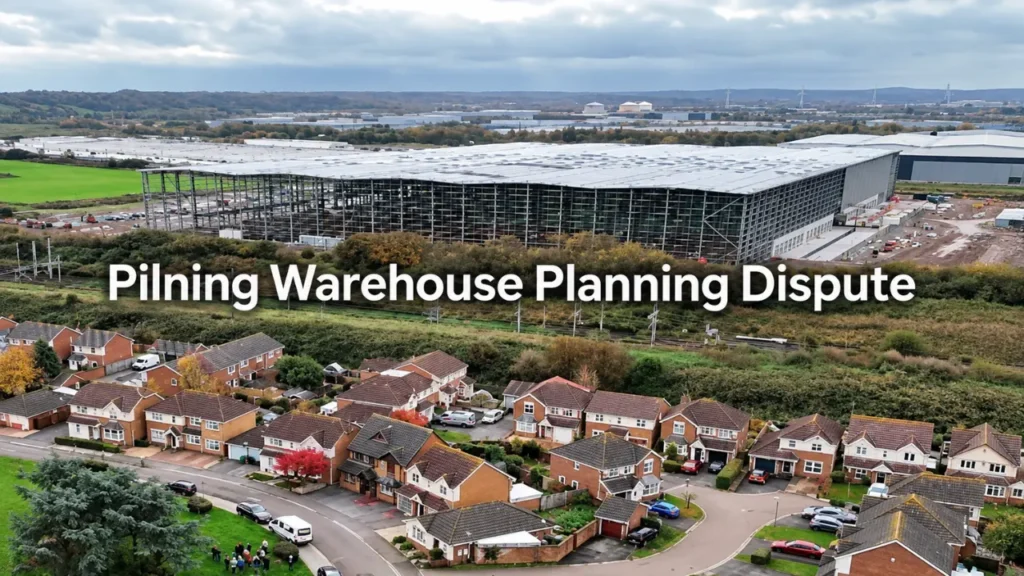
The scale of the warehouse is what made the issue so difficult for local residents to ignore. In a December 2025 parliamentary debate, MP Claire Young said the building was more than 20 metres high, stood about 150 metres from the closest homes at Cranmoor Green, and had been built on raised land. Residents have raised concerns about its visual impact, traffic, noise, lighting and possible flooding consequences.
The 1957 and 1958 consents are at the centre of the dispute
The history matters because the warehouse is not being considered through an ordinary modern planning application in the way residents might expect.
According to parliamentary records, planning permission was granted to Imperial Chemical Industries in 1957 and 1958 for the expansion of chemical, storage and distribution industries across an area of more than 1,000 hectares alongside and extending into the Severn estuary. The permissions were part of the post-war push to expand industry in the area.
The landscape around Pilning was very different when those permissions were created.
There was no M4, no M5 and no Severn bridges. Pilning was smaller, Cranmoor Green had not yet been developed, and the transport assumptions behind the original industrial plans were very different from those surrounding a modern distribution centre.
That historical gap is one of the strongest arguments raised by residents today.
The original planning decision may have been appropriate for its time. The question is whether it remains an adequate basis for developments of today’s scale.
Why the modern planning process is the biggest source of frustration
The most important feature of the pilning warehouse planning dispute is not simply the age of the permission. It is what that permission allows the planning authority to consider today.
In the parts of the Severnside site where reserved matters applications are required, the parliamentary record says the council’s consideration can be limited to matters such as layout, design and external appearance. Issues including access, parking, ecology, biodiversity net gain, residential amenity and flood risk cannot necessarily be reconsidered through that process in the same way as they would be under a fresh full planning application.
That distinction explains much of the anger in Pilning.
Residents can see a huge modern building appearing close to their homes and reasonably ask why the council cannot assess every consequence of that development under today’s standards.
The answer is rooted in the legal status of the old consent.
This does not mean the concerns are irrelevant. It means the planning authority’s ability to respond to those concerns is constrained by the permission already in existence.
The warehouse’s scale changed the character of the argument
The building itself has become a symbol of the wider dispute.
Parliamentary evidence describes it as more than 20 metres high and approximately 150 metres from the closest homes at Cranmoor Green. The site was also raised, which residents argue makes the building appear even more imposing.
A structure of this scale inevitably creates a visual impact.
The issue is particularly sensitive because Pilning is surrounded by open countryside and has historically had a village character. Residents who once looked across open land now face a large industrial structure.
That does not establish that the development is unlawful. It does explain why the visual impact has become one of the most powerful elements of the local campaign.
The pilning warehouse planning dispute is therefore about more than the existence of a warehouse. It is about the physical relationship between an enormous industrial building and nearby homes.
Traffic is one of the practical concerns residents cannot easily ignore
The next issue is traffic.
A modern warehouse depends on commercial vehicle movements. Residents have raised concerns about HGV traffic using the roads around Pilning and the potential effect on roads that were not designed around today’s distribution industry.
In Parliament, Claire Young referred to concerns about HGVs arriving around the clock and additional traffic travelling through surrounding country roads. She also highlighted the difference between the transport conditions when the original permissions were created and the conditions facing the area today.
That difference is important.
The 1950s planning permission could not have anticipated today’s logistics industry, with large distribution centres, extensive HGV movements and modern warehouse operations.
This is one reason residents argue that old permissions should not automatically determine the future scale of industrial development.
Noise and lighting have become part of the local argument
Traffic is only one part of the impact.
Residents have also raised concerns about noise and light pollution. Modern distribution facilities can operate for extended periods, meaning activity does not necessarily stop when surrounding residential areas become quieter.
The parliamentary debate referred specifically to concerns about refrigerated vehicles, forklift warning signals, loading activity and HGVs operating around the clock.
Lighting is another issue.
A major warehouse requires lighting for safety, vehicle movements and operational purposes. For homes close to the site, that can alter the appearance of the area after dark.
Again, the important point is not that every warehouse automatically creates unacceptable noise or lighting. The concern is whether residents had an effective opportunity to have those impacts assessed through the planning process.
That is where the historic consent becomes central again.
Flood risk has given the dispute another dimension
Flooding is arguably the most serious environmental concern raised in the debate because the development involves extensive construction and changes to the land.
Residents have questioned what happens to water when land is raised and large areas are covered with hard surfaces.
In Parliament, Claire Young highlighted concerns about the raised land and the possibility of increased flood risk. She also said she was seeking discussions involving the Environment Agency, the parish council and South Gloucestershire Council to understand those concerns more fully.
It is important to distinguish between a concern and a proven outcome.
Residents’ fears about flooding do not, by themselves, establish that the warehouse has increased flood risk. But the issue is clearly significant enough to have been raised with the relevant authorities.
That makes flood management an important part of the wider debate over whether historic planning consents remain suitable for modern development.
South Gloucestershire Council says the historic system needs changing
The council’s position has also moved the issue beyond a simple resident-versus-developer argument.
In June 2026, South Gloucestershire Council leaders wrote to the Secretary of State for Housing and Planning calling for government action over the historic industrial consents affecting Pilning and Severn Beach.
The council acknowledged that development taking place under the historic consents is lawful, while arguing that the arrangements pre-date modern planning policy and operate outside contemporary environmental, transport and community infrastructure requirements. The council called for legislation to update the outdated consents and give communities a more meaningful voice.
That is a significant development.
It means the criticism is not coming solely from residents. The local authority itself is asking central government to address what it sees as a structural problem.
The debate has therefore become a question of planning law and public policy as well as a local development dispute.
The issue has reached the House of Commons
The pilning warehouse planning dispute reached Parliament again in June 2026 through a petition concerning warehouse development in Pilning.
The petition stated that residents believed the development was having a major and lasting detrimental effect on the local community. It cited loss of countryside, increased noise, light pollution, flood concerns, increased traffic and concerns about property values.
It also argued that the 1957 consent was no longer fit for purpose in 2026 and called for it to be revoked or amended to introduce appropriate conditions and restrictions. The parliamentary record says the Severnside Warehouse Action group had submitted a petition with more than 2,500 signatures to South Gloucestershire Council and had more than 3,500 signatures online at the time of the debate.
The parliamentary attention does not itself change the planning permission.
What it does is put pressure on government to consider whether legislation can address historic permissions that do not contain the safeguards associated with modern planning decisions.
The dispute is bigger than one warehouse
One of the most important facts for anyone following the pilning warehouse planning dispute is that residents are not only worried about the building already under construction.
They are also concerned about what the historic permissions could allow in the future.
The 2025 parliamentary debate stated that the consents could facilitate further warehouse development around Pilning, Severn Beach and Easter Compton.
That creates a much bigger question.
If one large warehouse has already changed the appearance and experience of the area, what happens if additional warehouses follow?
The answer matters because the cumulative effect of several industrial buildings can be very different from the impact of one isolated development.
Traffic can increase. Industrial lighting can spread. Open land can disappear piece by piece. The boundary between village and industrial area can become increasingly difficult to define.
That is why the current dispute has attracted such strong local attention.
Future warehouse allocations are already being challenged
The wider development debate is continuing through South Gloucestershire’s Local Plan.
Pilning & Severn Beach Parish Council said in June 2026 that it had objected to a proposed allocation of land between Marsh Common Road and the mainline railway for additional warehouse development. The parish council described the land as Green Belt and said it had commissioned planning consultants to prepare a statement for the Local Plan examination.
The parish council also reported that South Gloucestershire Council was arguing for Green Belt changes to provide “Grow On Space” for Severnside, while the parish council disputed the evidence for that need. It also said the council intended to allocate Plots M and N at Severn Road for warehouse development.
This makes the dispute a question about the future shape of Severnside rather than simply the history of one planning consent.
Why changing the old permissions will not be simple
It would be easy to assume that a council or government can simply cancel an old planning permission.
The legal reality is more complicated.
The 1957 and 1958 consents were granted without the time limits that apply to many modern planning permissions. The 2025 parliamentary debate also highlighted that the Town and Country Planning Act 1990’s time-limit provisions do not apply to permissions granted by a development order in the same way.
That is one reason the issue has become a matter for central government as well as the local authority.
Changing the legal position could have consequences for development rights and compensation. Any reform would therefore need to be carefully designed rather than imposed as a quick response to public pressure.
The challenge is finding a way to introduce modern safeguards without creating a wider legal problem.
What makes Pilning different from an ordinary planning objection
Most planning disputes follow a familiar pattern.
A developer submits an application. Residents object. The planning authority assesses the proposal against relevant policies. A decision is made. There may be an appeal.
Pilning does not fit neatly into that pattern.
The underlying historic permissions change what can be examined when development proceeds under them. That is why residents have focused so heavily on the age and structure of the consent itself.
The strongest argument made by the community is therefore not simply “we dislike this warehouse.”
It is “the system did not give today’s community the same opportunity to raise today’s concerns.”
That is a much more difficult issue for policymakers to dismiss.
The economic case for Severnside still matters
There is another side to the argument that should not be ignored.
Severnside has an established industrial and logistics role. Warehousing can provide employment, support supply chains and contribute to the regional economy.
The question is not whether South Gloucestershire should have industrial activity.
The better question is where that activity should go, how large it should be and what conditions should apply.
Economic development does not have to conflict with community protection. But when the legal planning framework prevents modern safeguards from being applied properly, the balance becomes much harder to achieve.
That is precisely why the pilning warehouse planning dispute has become a wider planning-policy issue.
What happens next could set an important precedent
The next stage will depend partly on whether the government is willing to address the historic consents through legislation or another legal mechanism.
South Gloucestershire Council has explicitly asked for government action. Residents and community groups continue to campaign. Parliament has debated the matter, and future Local Plan decisions could determine whether additional warehouse land is allocated around Severnside.
There is no simple guarantee that the existing warehouse will be removed or that the 1957 consent will be revoked.
The more realistic significance lies in whether the rules governing old planning permissions can be modernised.
If that happens, Pilning could become an important example of how the planning system deals with development rights created generations ago but still capable of producing major consequences today.
The real lesson from the Pilning dispute
The pilning warehouse planning dispute exposes a basic problem with planning law: certainty is valuable, but certainty can become difficult to defend when the world around an old permission has changed beyond recognition.
The 1957 and 1958 permissions were created for a particular industrial vision. Today’s Pilning has different roads, different communities, different environmental expectations and a completely different logistics industry.
That does not make the original permissions irrelevant.
It does mean that policymakers need to confront the uncomfortable gap between an old legal right and modern community expectations.
Pilning residents are not asking whether Britain should have warehouses at all. Their argument is about scale, location, safeguards and whether people living next to major developments should have a meaningful say in their consequences.
That is the point government should address.
Conclusion: The warehouse is only the visible part of the problem
The pilning warehouse planning dispute is ultimately a test of whether Britain’s planning system can deal sensibly with permissions that have survived for almost 70 years.
The warehouse itself is impossible to separate from that history. Its height, proximity to homes, traffic implications, lighting, noise and potential flood concerns have made the old consent visible in a way that a legal document never was.
The most important question now is not whether Pilning can stop every warehouse.
It is whether a planning consent created in 1957 should still be capable of shaping a twenty-first-century community without the modern safeguards residents would expect today.
If the answer is no, Parliament and government need to fix the system rather than waiting for the next mega-warehouse to expose the same problem somewhere else.
FAQs
1. Why can the 1957 consent still affect warehouse construction today?
The historic consent was granted without the type of time limit normally associated with modern planning permissions, and parliamentary discussion has highlighted its continuing legal effect. That is why developers can still rely on the old planning framework for qualifying development.
2. Does the existence of the old consent mean every future warehouse is automatically approved?
No. The planning position depends on the particular development and the terms of the historic consent. Where reserved matters apply, however, the range of issues available for consideration can be much narrower than in a new full planning application.
3. What are residents most worried about with the current warehouse?
The concerns raised publicly include the building’s visual impact, HGV traffic, noise, artificial lighting and potential flooding consequences. Residents have also objected to the loss of countryside and the possibility of further warehouse development.
4. Has South Gloucestershire Council supported calls to change the historic planning arrangements?
Yes. In June 2026, council leaders wrote to the Secretary of State asking for government action to update the historic consents and bring future development closer to modern environmental, transport and community infrastructure standards.
5. Could more warehouse development be proposed around Pilning?
Yes. The wider Severnside development debate continues through South Gloucestershire’s Local Plan, including proposals involving additional warehouse land. Pilning & Severn Beach Parish Council has formally objected to at least one proposed allocation and has raised concerns about further industrial expansion.