
Introduction
Val Studio has built its reputation around the part of filmmaking that audiences notice only when it goes wrong. A convincing digital environment, invisible set extension, carefully tracked object, or realistic computer-generated element should feel as though it was always part of the shot. That is where professional visual-effects work earns its value, and it is also where Val Studio has concentrated its production capabilities.
The studio describes itself as a full-service visual-effects and computer-graphics studio focused on photorealistic computer graphics for movies, television, and commercials. Its stated work also extends into advertising, the music industry, and experimental visual installations. Rather than limiting its role to a single stage of post-production, the studio says it can support projects from early development through release, including planning, creative consultation, visual-effects production, and technical and creative control.
That approach matters because visual effects are rarely a one-person, one-software job. A finished shot may depend on concept work, camera information, tracking, modeling, texturing, animation, rotoscoping, effects, cleanup, compositing, and careful review. The quality of the final frame depends on how well those pieces fit together.
Val Studio focuses on visual effects that serve the story
The easiest mistake in discussing VFX is to treat spectacular imagery as the goal. It is not.
A good visual effect should answer a production problem or strengthen a creative decision. A digital environment might allow a director to place characters somewhere impossible to film. A set extension might make a modest location appear much larger. A computer-generated object might be safer or more practical than building a physical version. A background replacement might completely change the context of a scene.
Val Studio’s stated focus on photorealistic computer graphics reflects that practical side of VFX. The studio works across film, television, advertising, and music, where the visual requirements can be very different from one project to another.
The strongest work is usually not the work that demands attention.
If viewers are thinking about the visual effect instead of the character, action, or story, something has probably gone wrong. Realism comes from making the digital element behave like it belongs in the same physical world as everything else.
That requires considerably more than attractive CGI.
The production process starts before post-production
One of the more useful aspects of Val Studio’s stated workflow is its involvement during early project development. The studio says it provides consultation at early stages, helps plan VFX production, and maintains technical and creative control throughout production.
That matters because decisions made before filming can determine how difficult the visual-effects work becomes later.
Consider a scene that requires a digital environment. The camera angle, lighting, actor positioning, lens choice, and practical elements captured on set can all affect the eventual composite. If the VFX requirements are considered only after filming, the post-production team may have to compensate for choices that could have been handled more efficiently during production.
Early planning can prevent that problem.
Storyboards and concept development
The studio lists storyboard, concept-art, and matte-painting work among its 2D capabilities. These stages help establish the intended visual direction before the production reaches the final image.
A storyboard can establish composition and action. Concept art can establish the look of an environment or sequence. Matte painting can help visualize places that do not yet exist physically.
These are not merely decorative steps. They help a production decide what needs to be filmed, what needs to be created digitally, and how the different elements will eventually meet.
3D production gives filmmakers more room to build
Val Studio also lists a substantial set of 3D capabilities, including previsualization, modeling, texturing, animation, rotomation, and photogrammetry.
Each serves a different purpose.
Previsualization allows a production to explore a sequence before committing to the final version. Modeling creates the digital geometry required for an object, character, environment, or structure. Texturing gives those surfaces their visual properties. Animation controls movement, while rotomation can be used to reproduce or follow movement within a visual-effects workflow.
Photogrammetry adds another useful connection between the physical and digital worlds. Information captured from real objects or environments can help create digital representations suitable for further production.
The important point is that 3D work is not simply about making something that looks impressive on a computer screen. It has to survive inside the actual shot.
A digital object may look perfect on its own but fail once placed beside live-action footage. Its scale, perspective, surface, lighting, shadows, and movement all have to agree with the surrounding material.
Tracking and rotoscoping are the invisible work viewers depend on
Some of the most important VFX tasks are also the least noticeable.
Tracking helps digital elements follow the movement of the camera or objects within a shot. Without accurate tracking, an inserted element can appear to float, slide, or move independently from the scene.
Rotoscoping solves a different problem. It allows artists to isolate or manipulate parts of an image with detailed precision. This can become essential when foreground objects or people need to interact with digital environments.
Val Studio lists matchmoving, rotoscoping, cleanup, FX, and compositing among its VFX services.
These tasks rarely become the subject of promotional material, yet they are central to believable visual effects.
A viewer may never know that a particular shot required extensive tracking or frame-by-frame work. That is actually a sign that the work has succeeded.
Compositing is where separate elements become one image
Compositing deserves particular attention because this is where different pieces of a production are brought together.
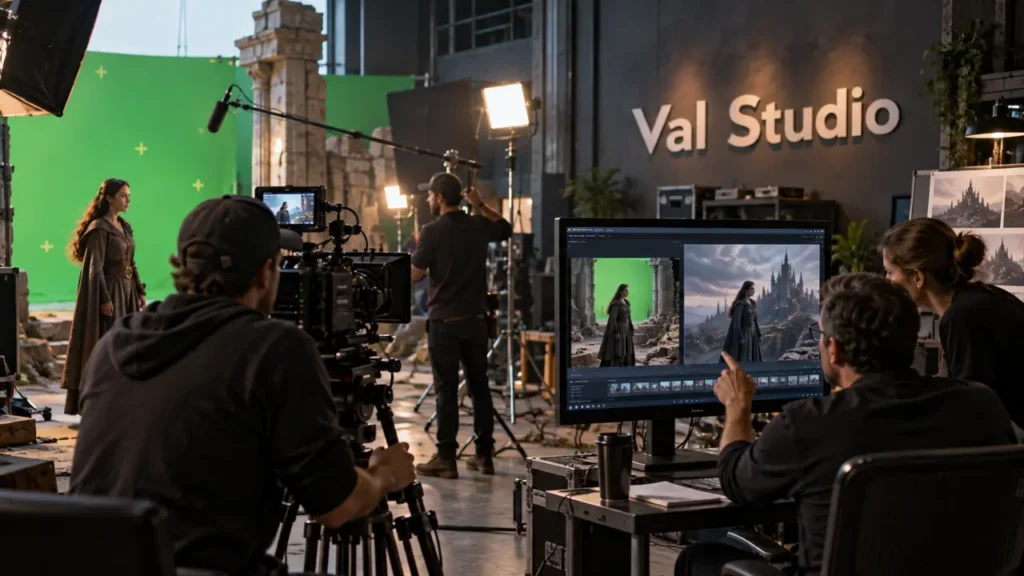
Imagine an actor filmed in front of a blue screen. The final scene may place that actor inside a completely different environment. The background must match the camera perspective. Lighting needs to make sense. Edges must remain clean. Shadows and reflections need to behave naturally. The color and contrast of the elements need to belong to the same visual world.
Val Studio lists compositing, green-screen replacement, blue-screen replacement, and set extension among its specialties.
This is where technical accuracy becomes visible.
A slightly wrong perspective can make an enormous digital building look like a miniature. An incorrect shadow can reveal that an object was added later. A poorly matched color grade can separate a character from the environment.
The individual pieces might all be impressive. The shot still fails if they do not agree.
Photorealistic CGI depends on detail and restraint
Photorealism is not achieved simply by adding more detail.
Real objects contain wear, irregularities, changing reflections, uneven surfaces, and subtle differences in lighting. A digital object can actually become less convincing when it is too clean or too perfect.
This is particularly important when CGI has to interact with live-action footage.
For example, a digital vehicle inserted into a real street needs to reflect the environment around it. Its windows should respond to the surrounding light. Its tires need to sit naturally against the road. Its movement needs to match the camera. The shadows have to agree with the scene.
That is why Val Studio’s combination of modeling, texturing, animation, tracking, and compositing is more significant than any single capability.
Realism is created through relationships between elements.
Val Studio has a filmography that shows the range of its work
The studio’s current filmography includes Kraken and Red Silk from 2025, Kibertaksi from 2024, Povelitel vetra and The Challenge from 2023, Kiberderevnya and Kiberderevnya. New Year from 2023, Mira from 2022, and Coma from 2020.
Earlier public material also associates the studio with projects including The Legend of Kolovrat, Ghost, Icebreaker, and T-34.
That project history is useful because it shows that the studio’s work is not limited to one visual format.
Different productions place different demands on a VFX team. One film may need extensive digital environments. Another may rely on character or object work. A commercial may require precise product imagery. A music project may give artists more freedom to experiment with visual style.
The underlying skills remain connected, but the creative decisions change from project to project.
Advertising brings a different set of VFX demands
Film gives a visual-effects team time to develop a story across an extended sequence. Advertising often works differently.
A commercial may have only a short amount of screen time to establish a product, location, mood, or visual idea. Every frame has to communicate something.
Computer graphics can be particularly useful in this environment because products and environments can be presented in ways that would be difficult to capture practically. Digital production can also give creative teams greater control over the appearance and movement of an object.
Val Studio specifically identifies commercials and advertising among the areas served by its photorealistic computer-graphics work.
The challenge is not simply creating attractive imagery. The visuals still have to support the purpose of the campaign.
The studio also works across stereo and 2D production
Val Studio’s service list extends beyond conventional VFX into stereo work, including 2D conversion and alignment.
That adds another technical consideration because stereoscopic presentation depends on how visual information is positioned and aligned for depth.
The studio also maintains 2D capabilities involving storyboards, concept art, and matte painting. That combination shows how modern VFX production crosses the boundaries between illustration, animation, compositing, and live-action filmmaking.
It is difficult to separate these disciplines completely.
A production may start with a hand-drawn idea, move into 3D previsualization, incorporate live footage, and finish with detailed compositing. The final image may look simple, but the process behind it can involve several specialized stages.
Why the studio’s end-to-end approach matters
Val Studio says it can guide a project from idea to release and provide technical and creative control throughout production.
That is important because communication becomes a major factor when a project contains complicated visual-effects work.
A creative decision made during pre-production can affect the work required by the 3D team. A change made during filming can affect tracking or compositing. A revision to the final shot can require adjustments across several connected assets.
Keeping those relationships clear can reduce avoidable problems.
It also gives filmmakers more freedom to think about VFX as part of production rather than as a repair service added at the end.
That distinction matters.
The best visual-effects planning does not ask, “How can we fix this shot?” It asks, “What should this shot become, and what needs to happen at every stage to get there?”
What separates convincing VFX from obvious CGI
There is no single trick that makes a digital image believable.
It comes down to dozens of decisions that viewers may never consciously identify.
Perspective must be right. Movement must feel natural. Materials must react appropriately to light. Digital elements need convincing contact with the environment. The camera needs to behave consistently. Edges have to hold up. Color needs to connect the elements.
Val Studio’s service range covers many of these stages, including modeling, texturing, animation, tracking, FX, rotoscoping, cleanup, and compositing.
That breadth is useful because visual effects are ultimately a chain. A weak link can undermine an otherwise excellent shot.
The strongest result is rarely the most complicated one. It is the one that gives the audience no reason to question what they are seeing.
The real strength of Val Studio is its production discipline
Val Studio is most interesting when viewed as a production partner rather than simply a company that makes CGI.
Its published capabilities cover early creative development, 2D work, 3D production, VFX, compositing, and stereo services. Its public filmography demonstrates involvement in feature-film and other screen projects across several years.
That combination gives the studio a place in the part of filmmaking where creative ambition meets technical reality.
And that is where VFX earns its keep.
A digital effect should not exist merely because the software can create it. It should exist because the story needs something that the camera alone cannot provide.
For Val Studio, the strongest measure of success is therefore not how loudly the effect announces itself. It is whether the finished image feels natural, intentional, and completely at home within the story.
That is the standard worth applying to any VFX studio: not how much it can put on screen, but how convincingly it can make the impossible belong there.
FAQs
1. Which industries does Val Studio publicly say it serves?
Its official profile identifies movies, television, commercials, advertising, music-industry projects, and experimental visual installations as areas of work.
2. What should a filmmaker prepare before starting a VFX project?
The exact requirements depend on the shot, but useful material can include storyboards, concept references, camera information, location footage, production plans, and clear descriptions of the intended result. Early planning is particularly important when digital elements will interact closely with filmed footage.
3. Does every VFX shot require 3D modeling?
No. Some shots may rely primarily on compositing, cleanup, rotoscoping, screen replacement, tracking, or other 2D techniques. The appropriate approach depends on what the finished shot needs to achieve.
4. Why can a small VFX mistake be so noticeable?
Viewers are accustomed to real-world relationships between light, perspective, movement, and physical objects. If a digital element violates one of those relationships, even subtly, the brain can recognize that something feels wrong.
5. Which Val Studio projects are listed most recently?
The studio’s current filmography lists Kraken and Red Silk for 2025, followed by Kibertaksi in 2024 and Povelitel vetra and The Challenge in 2023.